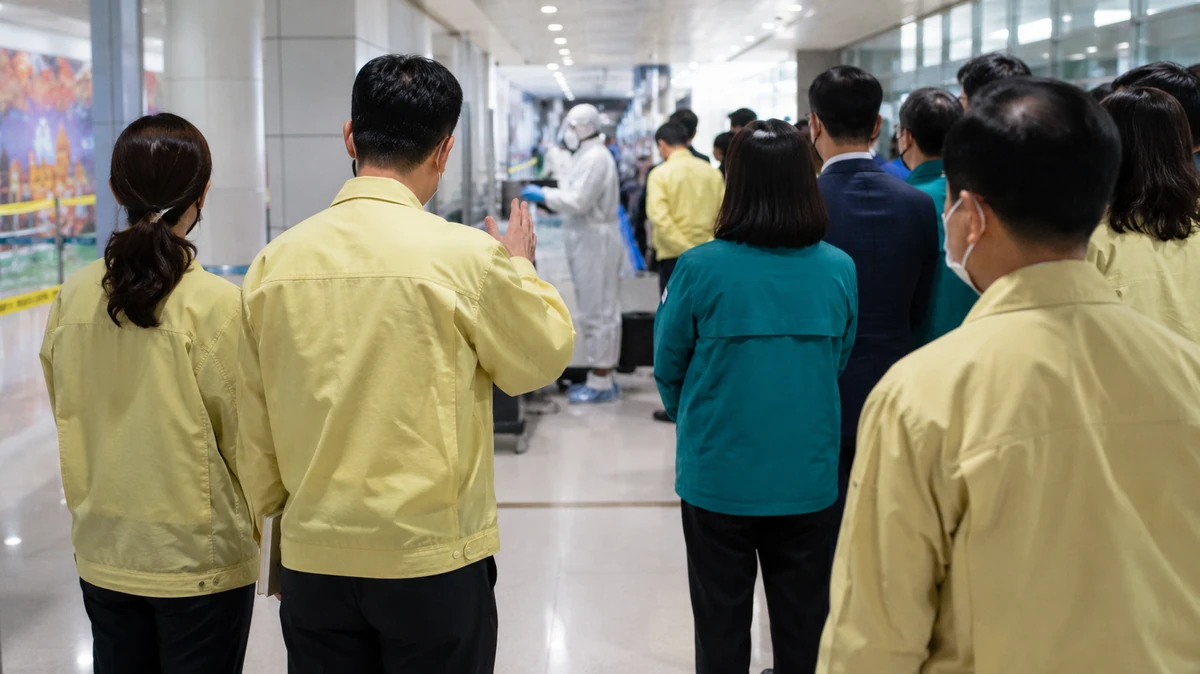
South Korea’s busiest gateway becomes the front line
South Korean health officials on June 4 moved to reassure the public that the country is not waiting for an Ebola case to appear before acting. Lim Seung-gwan, commissioner of the Korea Disease Control and Prevention Agency, visited the National Incheon Airport Quarantine Station to inspect how the country would respond if Ebola were carried into South Korea by an international traveler. The visit came as outbreaks in the Democratic Republic of Congo and Uganda have pushed Ebola back into the global spotlight and prompted intensified monitoring far beyond Africa.
For American readers, the scene may sound familiar. Think of the way U.S. airports, hospitals and local health departments became tightly linked during COVID-19, or the way public health agencies sharpened screening and coordination after isolated Ebola cases in the United States in 2014. South Korea is now trying to apply that same lesson to a different threat: infectious disease control is not just about what happens in a lab or a hospital, but about whether multiple systems — airports, local governments, emergency responders and clinics — can move together in real time.
That is why this inspection matters in South Korea beyond the health policy world. Incheon International Airport is not just the nation’s main airport; it is one of Asia’s largest global transit hubs, comparable in strategic importance to airports like Atlanta, Los Angeles International or JFK in the U.S. When South Korean officials inspect quarantine operations there, they are not simply reviewing airport paperwork. They are testing whether the country’s first line of defense against imported disease can function under pressure.
The government says it has already activated a response team, designated five countries including Congo and neighboring states as priority quarantine management areas, and built a 24-hour coordination network linking local governments and medical institutions to suspected symptom reports. That makes the airport inspection more than a symbolic photo opportunity. It is meant to show that the system is already in motion.
In a country where memories of the 2015 MERS outbreak still shape public attitudes toward disease response, officials know that trust depends on speed, clarity and coordination. South Korea learned then that a breakdown in communication can quickly become a national crisis. What authorities are trying to demonstrate now is that an outbreak overseas does not become a domestic emergency simply because planes keep landing. It becomes one only if the response system fails.
Why Ebola abroad is drawing attention in South Korea now
The immediate trigger for the heightened inspection effort is the worsening Ebola situation in parts of Africa, especially the Democratic Republic of Congo and Uganda. According to the Korean summary of the situation, the World Health Organization declared an international public health emergency in mid-May as case numbers climbed. That declaration matters because it tells governments that what may begin as a localized outbreak can create wider risks through international travel and cross-border movement.
Ebola is not spread as casually as respiratory viruses like the flu or COVID-19, and public health experts have long noted that transmission requires direct contact with the bodily fluids of a person who is sick or has died from the disease. But the virus carries an outsized level of concern for good reason. It is severe, often deadly, and capable of overwhelming health systems that are not ready to recognize and isolate cases quickly. A single missed case can trigger intense public fear, especially in countries where the disease is rare.
That makes the South Korean response less about suggesting an imminent domestic outbreak and more about recognizing how modern mobility works. An infection that emerges in central Africa can become a concern in East Asia, Europe or North America not because the disease is suddenly everywhere, but because the routes connecting the world are everywhere. Public health agencies now plan around that reality.
South Korea, like many trade-dependent countries, is highly exposed to international movement. Its business travelers, airline crews, students, aid workers and tourists move through dense networks of connecting flights. The Korean government’s decision to tighten quarantine measures reflects a view common in post-pandemic public health: by the time a disease becomes a visible domestic problem, officials have already lost valuable time.
For American audiences, it may help to think of this as a preparedness story rather than a panic story. In the U.S., airport-based health screening often becomes a visible symbol of state action during outbreaks, but the real test is whether that screening feeds into a larger system that includes rapid reporting, trained clinicians and local public health follow-up. South Korea appears to be emphasizing exactly that broader chain.
How the airport screening system is supposed to work
At Incheon, officials are relying on a layered approach rather than a one-size-fits-all model. The first part applies to travelers arriving on direct flights from Ethiopia, which is significant because it is a major African aviation hub with direct connections into South Korea. These passengers are required to report their health status either through Q-CODE, South Korea’s digital health declaration system, or through a paper health questionnaire.
Q-CODE may be unfamiliar to readers outside Korea, but the concept is straightforward. It functions as a pre-arrival or arrival health reporting tool that allows travelers to submit information about their condition before they move fully into the country. Americans saw similar digital forms, screening questionnaires and vaccination-verification systems during the pandemic, although the U.S. approach was often fragmented across airlines, federal agencies and states. South Korea has generally favored centralized, tech-enabled entry systems, and Q-CODE reflects that administrative style.
The second layer is more selective. Travelers who began their journeys in one of the priority quarantine management areas but entered South Korea after transiting through a third country are subject to targeted gate screening. In practical terms, that means officials are not looking only at direct routes. They are watching travel paths. A passenger who left a higher-risk area but changed planes elsewhere may still be flagged for closer screening.
That distinction is important because modern air travel rarely follows neat, single-route lines. Someone may begin in one country, transfer through Addis Ababa, Doha, Istanbul or another global hub, and arrive in Seoul without the itinerary instantly signaling the original point of departure to a casual observer. Targeted screening is South Korea’s way of acknowledging that risk does not disappear because it passes through another airport first.
Public health officials often describe this as risk-based allocation of resources. Not every arriving passenger receives the same level of scrutiny, because not every route presents the same level of concern. Instead, the country is trying to apply more intensive measures where the risk profile is higher. In theory, that is more practical and more sustainable than treating every traveler as equally likely to be carrying a rare disease.
Still, the airport itself is only the visible part of the process. South Korean authorities are framing entry screening as the beginning of a chain, not the end of one. A health declaration, a gate-level check, an evaluation of symptoms and a referral into a medical or local-government response system are meant to connect seamlessly. The idea is to create multiple chances to catch a possible case, even if the first checkpoint misses it.
The bigger story is coordination, not just quarantine
If there is one central message in South Korea’s approach, it is that quarantine alone is not enough. The Korean health agency has emphasized that local governments and medical institutions are operating a 24-hour cooperation system so they can respond immediately to suspected symptoms. That means the airport is not being treated as a sealed perimeter capable of solving the problem by itself. It is one node in a much wider network.
This may sound bureaucratic, but it gets to the heart of modern outbreak control. A traveler can pass through an airport while feeling healthy, develop symptoms later and end up in a neighborhood clinic or emergency room. If the clinic does not recognize the risk, or if information does not move quickly between agencies, the country loses the advantage that airport screening was supposed to provide. That is why public health professionals focus so much on communication chains.
South Korea’s system, as described in the summary, is designed to keep that chain intact. Travelers report their condition at entry. Quarantine officers identify possible concerns. Local governments stand ready to respond. Medical institutions are expected to recognize and manage suspected patients. In effect, the country is building several layers of defense, each meant to compensate if the layer before it falls short.
For Americans, the broader lesson is easy to recognize. During major health emergencies, debates often center on what happens at the border: whether people should be screened, tested, restricted or monitored. But experienced public health officials usually say the more important question is what happens after someone gets through. Do healthcare workers know what to look for? Does a county health department get alerted? Is there a protocol for isolation and transport? South Korea appears to be asking those same questions now.
This also helps explain why an on-site inspection by the head of the disease agency carries political and social weight. In South Korea, visible administrative checks can serve both an operational and a public-confidence function. Officials are showing they are not simply issuing memos from Seoul. They are physically reviewing whether frontline procedures match the written plan. In a society that expects the state to be organized and responsive during crises, that kind of inspection sends a message of seriousness.
What South Korea’s response says about post-pandemic public health
The methods highlighted at Incheon suggest how disease control has evolved since the first chaotic months of COVID-19. The emphasis now is less on blanket restrictions and more on data-driven sorting: identify the routes of greatest concern, collect health information early, and connect that data to a system capable of quick intervention. In Korean terms, Q-CODE and targeted quarantine represent a more fine-tuned model of public health management.
That is a notable shift because it reflects a balancing act many governments are still trying to master. Close the borders too aggressively, and you disrupt travel, trade and public life. Do too little, and you risk being accused of complacency. South Korea’s current approach suggests it is trying to avoid both extremes by relying on risk signals rather than universal disruption.
The focus on travelers from or through designated management areas also shows an acceptance of a basic reality: in an era of dense global mobility, disease control depends increasingly on tracing patterns, not just stamping passports. Where a flight originated, where a traveler connected, what symptoms were declared and how quickly that information is passed along all matter. Public health is becoming as much about logistics and information systems as it is about medicine.
That evolution will look familiar to anyone who watched airports become data hubs during the pandemic. Health declarations, QR code systems, digital forms and automated risk flags were once seen as emergency tools. In places like South Korea, they have increasingly become part of a normal preparedness infrastructure. Whether that is reassuring or unsettling may depend on one’s view of state surveillance and public health authority, but the trend is clear.
In the Korean context, there is also a cultural dimension worth explaining. South Korea often responds to public risk through highly organized administrative systems, especially when the threat can be measured, logged and routed through technology. That does not mean the system is flawless, but it does mean the state tends to favor structured compliance mechanisms over ad hoc individual discretion. Q-CODE fits squarely into that model: submit information, classify risk, trigger follow-up if needed.
What the public should watch next
For now, the key fact is not that South Korea has detected Ebola inside its borders, but that it is preparing for the possibility of importation before any domestic case is confirmed. That distinction matters. Preparedness stories can easily be mistaken for crisis stories, especially with a disease as feared as Ebola. But what officials appear to be signaling is that the news value lies in the readiness of the system, not in evidence of an outbreak at home.
The next important question will be whether the measures remain adaptable. Outbreaks change. Travel patterns shift. Countries may be added to or removed from priority monitoring lists. Screening systems work best when they are updated quickly and when frontline workers understand not just the rulebook, but the reason behind it. If the international situation worsens, South Korea may need to widen its focus or intensify cooperation with airlines, hospitals and local governments.
Another point to watch is how transparently authorities communicate with the public. One of the enduring lessons of both MERS in South Korea and Ebola-related anxiety in the U.S. is that fear grows fastest in information gaps. If South Korean officials want to avoid unnecessary alarm, they will need to keep explaining what Ebola is, how it spreads, what the actual level of domestic risk is and what procedures are already in place if a suspected case appears.
That communication burden extends beyond government. Hospitals and clinics will play a crucial role because they sit at the point where public worry and medical judgment meet. A robust airport screening system can buy time, but it cannot replace informed clinicians. If South Korea’s response is as connected as officials say, the success of the system will depend not just on airport gates and digital forms, but on whether doctors and local responders can act quickly when a red flag emerges.
For an American audience, the broader significance of this story is not uniquely Korean. It is a reminder that global public safety increasingly depends on invisible systems of coordination most travelers barely notice. The airport line, the health form, the symptom check and the clinic alert are all part of a chain designed to prevent a single imported infection from becoming something larger. South Korea’s inspection at Incheon is one snapshot of how that chain is being tested in real time.
In the end, the most important takeaway is not about Ebola alone. It is about how a country translates an international warning into domestic action. The World Health Organization raises the alarm. National agencies designate high-risk areas. Airport officers screen arrivals. Local governments and hospitals prepare to respond around the clock. Each step is only partial on its own. Together, they form the kind of connected system that public health officials hope can stop a threat before most people ever feel its presence in daily life.
That is the story unfolding at Incheon: not a dramatic shutdown, not a scene of visible chaos, but a test of whether modern public health can work as intended — early, quietly and across institutions — while the world is still watching events unfold somewhere else.
Comments
Post a Comment