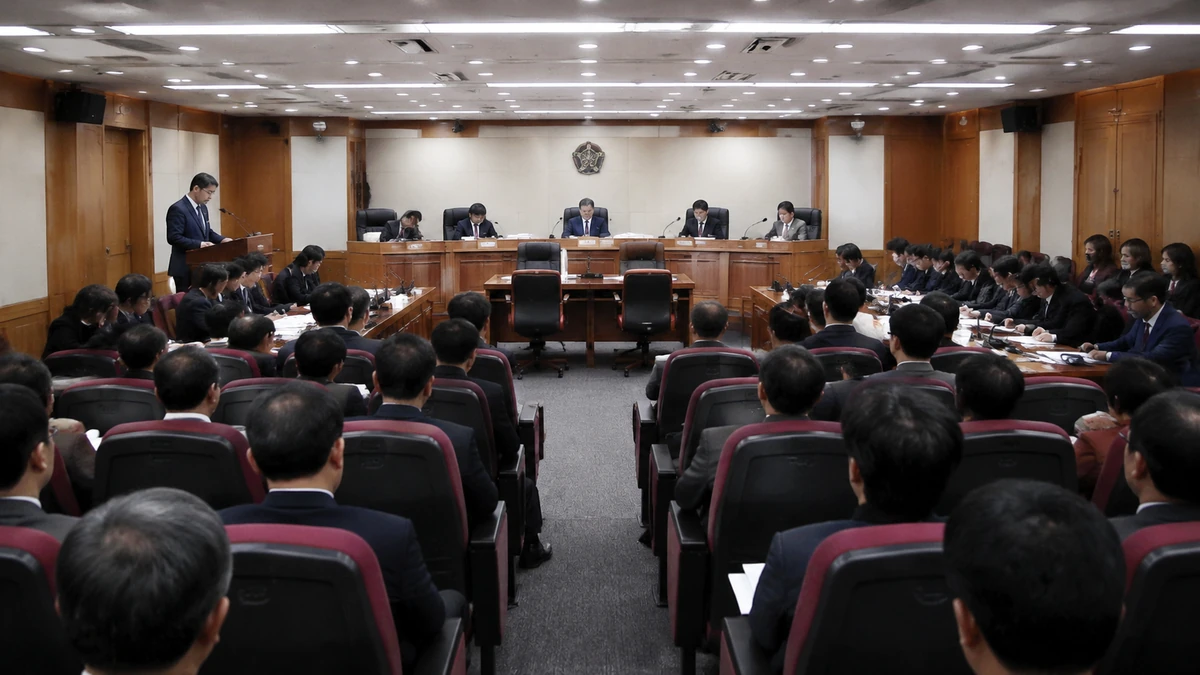
A landmark labor ruling in South Korea tests the limits of contractor accountability
A closely watched labor ruling in South Korea is sharpening one of the hardest questions in modern construction and supply-chain management: When work is done by subcontractors, how much responsibility still belongs to the company at the top?
On June 4, South Korea’s National Labor Relations Commission, the country’s central labor dispute body, partially recognized two major construction firms — Jungheung Torcon and Jungheung Construction — as employers for the purposes of bargaining with a subcontractor union on industrial safety issues. The commission ordered the companies to publicly announce that the subcontracted union had requested collective bargaining, a procedural step that carries real legal and symbolic weight. At the same time, the commission declined to extend that same recognition to wage-related demands.
The split decision may sound technical, but in South Korea it is being read as a major early test of how far labor responsibility can reach in workplaces built around layers of subcontracting. It is also one of the first significant cases to show how the country’s newly implemented so-called Yellow Envelope Law may be interpreted in practice.
For American readers, the closest analogy may be the long-running debate over whether a franchisor, a lead contractor or a platform company should be treated as a joint employer when it does not directly sign a worker’s paycheck but still shapes the work through rules, schedules, safety protocols and on-site control. The Korean case does not answer every part of that debate. But it does something important: It says that in at least some circumstances, especially safety, formal contract language alone cannot be the final word.
That matters far beyond one job site. In industries where a lead company oversees the pace, layout and risk management of work while subcontractors handle payroll and direct hiring, the question of who must sit down at the bargaining table goes to the heart of workplace power. It determines who can fix hazards, who can be pressured to act and who can say, in effect, that the problem belongs to someone else.
The June 4 decision suggests that South Korea’s labor authorities are willing to look past organizational charts and ask a more practical question: Who actually controls the conditions that make work dangerous or safe?
Why this case matters in South Korea’s construction industry
Construction in South Korea, like in many developed economies, often runs on a multilayered subcontracting system. Large developers and prime contractors oversee major projects, but a significant amount of actual work is handled by smaller firms lower in the chain. On paper, responsibility can appear neatly divided. In practice, the lines are often blurred.
That is especially true on large building sites, where timing, crane placement, site access, movement of heavy materials and coordination among multiple trades can create life-or-death consequences. A tower crane operator may be employed by one company, take instructions through another layer of management and still be working in a physical environment whose overall rhythm is determined by the lead contractor.
The union at the center of this dispute represents tower crane operators, workers who handle one of the most dangerous and essential pieces of equipment on a construction site. In any country, crane operations are a vivid example of how safety depends not just on the individual worker or immediate employer but on the choreography of the entire site. If schedules are compressed, if access routes are poorly managed, if loads are rushed or if communication breaks down, the risk escalates quickly.
That background helps explain why the labor commission drew a distinction between industrial safety and wages. Safety on a construction site is not merely an internal human resources matter for the subcontractor. It is deeply tied to how the broader project is run. Wages, by contrast, are more easily understood as part of the subcontractor’s independent business relationship with its employees, even if larger market pressures from the top of the chain affect what that subcontractor can pay.
South Korea has had repeated national conversations about dangerous work being pushed downward through subcontracting arrangements. Industrial accidents, particularly in construction and heavy industry, have fueled public anger and legislative reform. Korean labor activists have long argued that lead firms should not be able to keep effective control over production and safety while disclaiming responsibility whenever something goes wrong.
This case lands in that social and political context. It is not just about whether one union gets a notice posted. It is about whether Korean labor law will increasingly treat authority over risk as inseparable from responsibility for addressing it.
The key distinction: Safety yes, wages no
The most consequential part of the ruling is not that the commission sided broadly with labor or broadly with management. It is that the commission refused to treat all bargaining topics the same.
In its review decision, the National Labor Relations Commission found that the prime contractors could be recognized as employers, but only in a limited and issue-specific way. On industrial safety matters, the commission concluded that the lead firms were in a position to exercise real and concrete control or decision-making authority. Because of that, it said they must publicly announce the union’s bargaining request.
On wage issues, however, the commission took a different view. It said labor and management may still engage in voluntary talks aimed at institutional improvement, but wage-related demands could not be treated in the same way as subjects requiring recognition of the prime contractor as an employer with real and concrete power over those decisions.
That distinction is likely to shape Korean labor disputes for months, if not years. It signals that authorities may examine each issue on its own terms rather than making a sweeping determination that a prime contractor either is or is not an employer for every purpose. In practical terms, that opens the door to a more granular approach: safety, site control and operational risk may trigger broader responsibility, while pay and compensation may remain closer to the subcontractor’s side of the ledger.
For American audiences, that resembles the way courts and regulators sometimes parse different aspects of workplace control in disputes over joint employment, independent contracting or labor standards enforcement. One entity may control the premises, productivity metrics or safety regime, while another handles hiring, wages and discipline. The legal system then has to decide which kind of control matters for which obligation.
The Korean ruling does not erase those distinctions. Instead, it formalizes them. That may frustrate people hoping for a clear all-or-nothing answer, but it reflects the reality of modern labor structures. Companies often divide authority by design. The law is now being asked to follow that division closely enough to identify where responsibility still sticks.
In that sense, the ruling is both expansive and restrained. It expands accountability in one critical area — safety — while rejecting the idea that every demand by a subcontractor union automatically reaches the prime contractor. That balance may make the decision more durable, because it is grounded in observable control rather than ideology.
The Yellow Envelope Law and why this is being watched so closely
The ruling carries added significance because it comes after the implementation of South Korea’s Yellow Envelope Law, a politically charged labor measure that has drawn intense debate from unions, business groups and lawmakers.
The law’s nickname comes from a well-known episode in Korean labor history, when supporters sent donations in yellow envelopes to help workers facing crushing legal claims. Over time, the phrase came to symbolize a broader push to protect labor activity and narrow the ways companies can use damage claims and restrictive interpretations of employer status against workers and unions. In South Korea, where labor disputes can become highly politicized and where subcontracting is deeply entrenched, the measure has been seen as a test of whether the law will meaningfully strengthen workers’ ability to confront the companies that hold actual power.
The June 4 decision is especially notable because it overturned an earlier ruling by a regional labor commission in South Jeolla Province that had rejected the claim. That reversal underscores how unsettled this legal terrain remains. The first answer from one level of the system was no. The answer on review from the central commission was partially yes.
That alone makes this an important marker for lawyers, unions and corporations trying to understand what the new legal environment will look like. Major legislation often sounds transformative when it passes, but its real meaning only emerges through early cases. The first disputes become the proving ground. Regulators and adjudicators have to decide whether to read the law narrowly, broadly or somewhere in between.
What happened here suggests that South Korea’s labor authorities may be moving toward a fact-specific interpretation rather than a sweeping doctrinal revolution. That may disappoint activists who want a stronger and faster expansion of prime contractor responsibility. It may also worry business groups that hoped the law’s reach would remain minimal. But for observers trying to predict the future, the case offers a practical template: show concrete control over a specific issue, especially safety, and the lead company may not be able to stand at arm’s length.
In a global economy increasingly organized through contracting chains, that is a message that extends well beyond South Korea. Whether in logistics, warehousing, food service, app-based work or construction, lawmakers across democracies are wrestling with a similar question: Should legal responsibility follow the paycheck, or should it follow power?
What the order to announce the bargaining request actually means
One of the easiest parts of this story to underestimate is the remedy itself. The commission did not order an immediate sweeping settlement. It ordered the prime contractors to publicly announce the fact that the subcontractor union had requested bargaining on industrial safety issues.
That may sound procedural, even modest. It is not. In labor relations, formal acknowledgment of a bargaining request is often the gateway to everything that follows. Before parties can negotiate, mediate or define the scope of a dispute inside a legal framework, there must first be recognition that the request has been properly made to a party with obligations under the law.
By ordering the announcement, the commission effectively said the union’s safety demands are not merely an internal matter for the subcontractor. They are significant enough, and the prime contractor’s control is substantial enough, that the lead firm must publicly engage with the request as a legitimate counterpart in that area.
That has both legal and political consequences. Legally, it creates a foothold for unions representing subcontracted workers to direct certain demands higher up the chain when they can show the top-tier company has meaningful control over the conditions at issue. Politically, it undercuts one of the most common defenses in subcontracted industries: that the company most capable of fixing the problem is not technically the employer and therefore not the proper target of bargaining.
For workers, especially in hazardous jobs, that distinction matters enormously. If the subcontractor has limited power to redesign schedules, alter traffic patterns, impose new safety procedures across trades or slow down production when conditions become dangerous, bargaining only with that subcontractor may leave the most important decisions untouched. The commission’s order recognizes that reality, at least in part.
For companies, the decision is likely to intensify efforts to argue carefully about the boundaries of each bargaining topic. If safety can trigger bargaining obligations because it ties directly to site control, employers may push harder to define where safety ends and where managerial discretion or subcontractor autonomy begins. They may also try to structure operations and contracts in ways that preserve influence without creating an easily provable record of direct control.
In other words, the ruling does not end the fight over responsibility. It changes the terrain on which that fight will be waged.
How this fits into a broader global debate over subcontracting and worker safety
What makes the South Korean case especially relevant to international readers is how familiar its underlying tension is. Across advanced economies, companies have spent decades redesigning work through outsourcing, staffing agencies, franchising and subcontracting. Those arrangements can improve efficiency and shift costs, but they also complicate accountability.
When something goes wrong, the lead company may point to the contract and say the workers belong to another firm. Yet the same lead company may set delivery targets, determine site rules, dictate workflow, approve access, control information and shape the very environment in which injuries happen. Workers and unions then argue that any system that ignores that practical authority is disconnected from reality.
American readers have seen versions of this in debates over warehouse quotas, gig platform oversight, fast-food franchising and construction site liability. Regulators, courts and lawmakers repeatedly confront the same puzzle: How do you assign responsibility in a business model deliberately designed to spread it out?
South Korea’s June 4 ruling offers one answer, though not a universal one. Responsibility may be issue-dependent. If the lead company has tangible, on-the-ground control over a matter like safety, labor law may treat it as more than a bystander. But where decision-making remains more squarely in the hands of the subcontractor, such as direct wages, the law may stop short.
That approach has obvious practical appeal. It avoids pretending every contractual relationship is fake, while also avoiding the fiction that contracts alone define power. It invites a factual inquiry into who really makes the decisions that shape workers’ lives.
Still, the approach has limits. It can produce case-by-case uncertainty, prolonged litigation and strategic line-drawing by both employers and unions. Companies may say they are being pulled into bargaining over issues they only partly control. Unions may say the wage-safety divide understates how tightly compensation and safety are linked in real life, especially when low bids, tight margins and speed pressure contribute to dangerous conditions.
Those tensions are unlikely to disappear. If anything, this ruling may produce more disputes, not fewer, because it gives both sides a new framework to test. Labor groups may refine their demands to focus on subjects where prime contractor control is easiest to show. Employers may challenge those claims with increasing specificity. Future cases will determine whether June 4 was the beginning of a broader trend or a narrowly confined precedent.
What comes next for Korean labor, business and the law
The most important takeaway from the ruling is not that South Korea has fully redefined employer status. It has not. Nor has it left the old framework untouched. Instead, the central labor commission has drawn a sharper line around the idea that responsibility should track real control, at least in areas where danger on the ground is shaped by the lead contractor’s decisions.
That will likely influence how unions organize their claims. Rather than presenting bargaining demands as a single package, labor groups may increasingly separate issues by subject matter and build factual records showing exactly where a prime contractor directs site conditions, safety systems or operational risk. In other words, this decision may reward precision.
It also sends a warning to major firms. If they exercise enough influence over how a site functions, they may face bargaining obligations even when workers are not on their direct payroll. The more deeply they manage schedules, access, equipment placement and hazard prevention, the harder it may be to argue they are merely observers.
At the same time, the refusal to recognize wage demands in the same way gives companies an important limit they can cite going forward. Business groups are likely to emphasize that the ruling did not create open-ended responsibility and that labor authorities still recognize meaningful boundaries around subcontractor independence.
That mixed message may be exactly why the case matters. It is not a slogan in legal form. It is a nuanced, practical attempt to map responsibility onto the fragmented way work is actually organized. In that sense, it is less a final answer than a framework for future conflict.
For South Korea, a country with a technologically advanced economy, globally known conglomerates and a long history of high-stakes labor politics, the ruling captures a larger social question: In workplaces built through layers of contracting, can the law still identify the person — or company — with the power to prevent harm?
The June 4 decision suggests the answer is yes, but only if that power can be shown with specificity. That may sound modest. In practice, it could be the beginning of a significant shift.
As more disputes emerge under the Yellow Envelope Law, courts, labor commissions and companies will all be forced to grapple with the same basic principle now moving to the center of Korean labor policy: If you control the risk, you may not be able to avoid the responsibility.
Comments
Post a Comment