At a Seoul Palace, South Korea and France Mark 140 Years of Ties With a Diplomatic Message for the Present
A ceremonial anniversary with a practical purpose
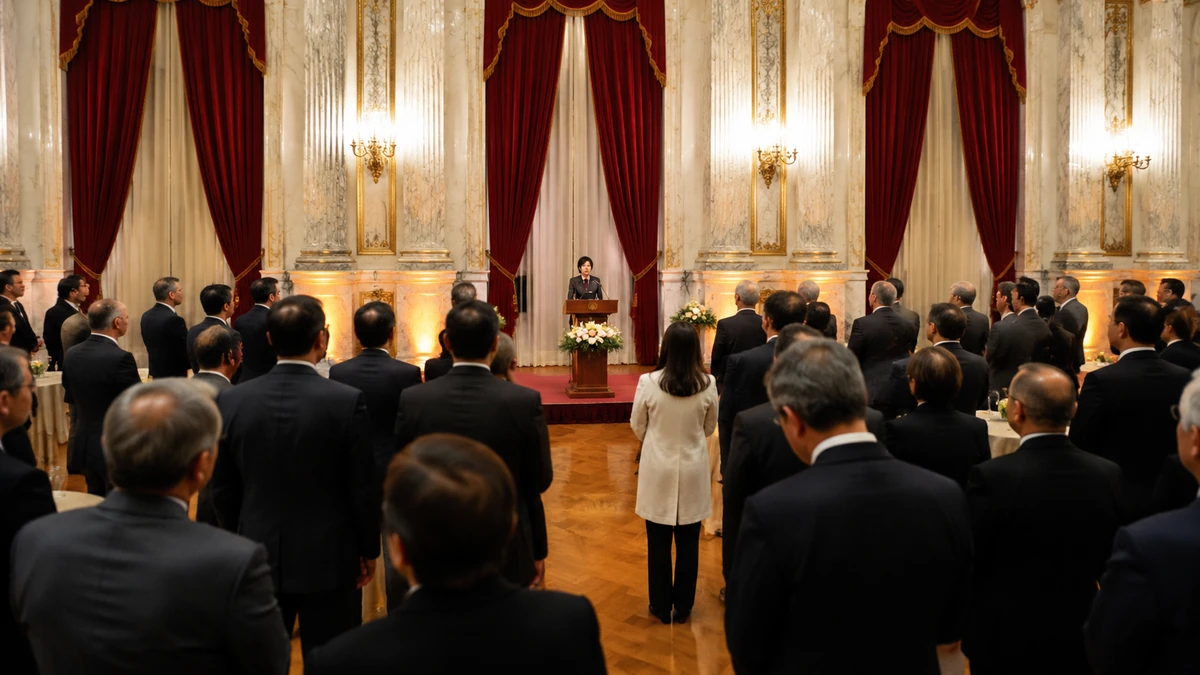
In diplomacy, anniversaries can easily become exercises in nostalgia: formal speeches, carefully staged photographs and a round of polite applause for history. But the event South Korea hosted this week to mark 140 years of diplomatic relations with France carried a more contemporary message. Held at Seokjojeon, a Western-style stone hall inside Seoul’s historic Deoksu Palace complex, the ceremony was less about looking backward than about showing how Seoul wants one of its most important European relationships to be understood today.
According to the South Korean presidential office and local reporting, first lady Kim Hye-kyung attended the June 4 commemoration and delivered remarks emphasizing friendship, trust and expanding cooperation between the two countries. Also in attendance were French Ambassador to South Korea Philippe Bertoux, members of the diplomatic corps from the European Union and Group of Seven countries, South Korean government officials and business representatives from both countries. Roughly 80 people took part — a relatively modest number, but one that reflected the event’s purpose. This was not a mass celebration. It was a carefully composed diplomatic tableau.
For American readers, it may help to think of the occasion less as a gala and more as a signaling event — the sort of public ceremony where symbolism matters because it reveals priorities. Governments use these settings to communicate tone as much as policy. There was no new treaty unveiled, no sweeping bilateral initiative announced, no headline-grabbing economic package. Yet in some ways that made the message clearer: South Korea was using the 140th anniversary to reaffirm that its ties with France are not simply historical artifacts, but active, working relationships grounded in culture, commerce and shared political trust.
That is significant for a country like South Korea, which is often framed abroad primarily through the lenses of North Korea, semiconductors, trade or security alliances. Seoul increasingly wants to be seen not just as a frontline democracy in East Asia or a manufacturing powerhouse, but also as a country with cultural reach and diplomatic sophistication. France, for its part, remains one of Europe’s central powers — politically influential inside the European Union, globally visible in culture and diplomacy, and a country with enduring prestige in areas ranging from luxury goods to defense to the arts. A commemoration like this becomes, in effect, a way for both sides to say that their relationship reaches beyond protocol.
Why the setting and the guest list mattered
The choice of venue carried its own meaning. Deoksu Palace occupies a special place in modern Korean history. Located in central Seoul, it stands at the intersection of Korea’s royal past and its encounters with foreign powers in the late 19th and early 20th centuries. Seokjojeon, in particular, is a striking example of Western architectural influence inside a Korean palace compound. Staging a Korea-France anniversary there was not accidental. The location visually reinforced the idea of exchange across distance, language and tradition — one of the themes Kim emphasized in her remarks.
That kind of visual symbolism is common in statecraft, and South Korea has become adept at it. Just as American presidents might host foreign leaders at the White House or Independence Hall to tap into a larger historical story, South Korean officials often use palace sites, memorial spaces and culturally resonant backdrops to frame a diplomatic message. The point is not simply aesthetic. It is to make the venue itself part of the argument.
The attendee list also revealed why this event mattered. Had the ceremony included only diplomats, it might have been read as ceremonial housekeeping: a courteous nod to a longstanding bilateral relationship. Had it included mostly corporate leaders, it might have looked like a business networking function draped in diplomatic language. Instead, the presence of government officials, ambassadors, diplomatic representatives from allied countries and business figures suggested something broader. South Korea was presenting diplomacy as an interconnected field in which politics, culture and economics move together.
That approach reflects a larger shift in how middle and major powers alike conduct international relations. In a world where national image can shape tourism, investment, education ties and even strategic influence, diplomacy no longer lives only in foreign ministries. It also lives in film, music, university exchanges, museum exhibitions, technology partnerships and corporate boardrooms. South Korea understands that especially well because of the Korean Wave, or Hallyu — the global spread of Korean popular culture, including K-pop, television dramas, film, fashion and food. France, meanwhile, long ago mastered its own version of cultural statecraft through art, literature, cuisine and an enduring brand of republican ideals associated with liberty, creativity and intellectual life.
The diplomatic language behind Kim Hye-kyung’s remarks
Kim’s speech, as described by South Korean officials, leaned heavily on phrases like “trust,” “friendship” and “close partners.” In everyday conversation, those words might sound soft or generic. In diplomatic speech, they are anything but casual. Such wording is often carefully chosen to communicate stability and predictability — qualities governments value especially in a period of geopolitical uncertainty.
Kim said Korea and France had opened their hearts to one another 140 years ago despite differences in language, culture and distance. She also said the mutual understanding the two countries built on trust and friendship has continued to widen and deepen, making them close partners who understand and empathize with one another through exchanges in daily life. That line did two things at once. First, it acknowledged the formality of state-to-state relations. Second, it moved the conversation into the realm of lived connection: the way ordinary people encounter each other through culture, education and social exchange.
That second point is important. Diplomatic anniversaries often risk sounding abstract, especially to audiences outside government. By invoking daily life, Kim’s remarks framed the relationship not just as one maintained by elites, but as one sustained by public familiarity. In practical terms, that can mean everything from Korean pop concerts and film festivals in France to French literature, art and luxury brands finding devoted audiences in South Korea.
For U.S. readers, there is a parallel in how America often talks about its closest allies. Washington may point to formal defense commitments or trade agreements, but it also highlights student exchanges, tourism, research collaboration and cultural affinity. These “soft” factors are often what give hard policy relationships durability. South Korea’s message this week suggested that it sees its relationship with France in similarly layered terms.
There was another notable feature of the first lady’s remarks: the language of connection rather than transaction. She did not present the relationship as a list of mutual benefits to be negotiated case by case. Instead, it was described as something cumulative — built over time, reinforced through empathy and now mature enough to be called a partnership. That is a subtle but meaningful distinction. It suggests that Seoul wants its ties with France to be understood as resilient and values-based, not merely useful.
When culture becomes diplomatic infrastructure
One of the clearest themes of the event was that culture is not peripheral to diplomacy; it is part of diplomacy itself. Kim noted that many French people have embraced Korean cultural content and K-pop, while many South Koreans admire France through the literature of Victor Hugo and the art of Claude Monet and Auguste Rodin, as well as what she described as France’s spirit of liberty and creativity.
This kind of rhetoric may sound ceremonial, but it points to something real. South Korea’s rise as a cultural force has changed the way it is perceived abroad. Just a generation or two ago, many Americans knew the country mainly through the Korean War, its split with North Korea or later through brands like Samsung and Hyundai. Today, South Korea is equally likely to be encountered through BTS, “Parasite,” Netflix dramas, beauty products, Michelin-caliber dining and a broader global fascination with Korean style. That cultural presence has given Seoul a wider diplomatic vocabulary.
France, of course, has long been a cultural superpower in its own right. For Americans, references to France often bring to mind Paris, the Louvre, haute couture, French cinema, existentialist philosophy and the language of the Enlightenment. In South Korea, French cultural influence has its own history. French literature and art have held prestige in Korean intellectual and educational circles for decades, and French luxury brands, cuisine and aesthetics remain highly visible. By highlighting that mutual recognition, Kim’s remarks underscored reciprocity — the idea that each country is not merely exporting culture to the other, but also receiving and valuing what comes back.
That reciprocity matters because cultural influence can often become one-directional, especially when one country’s entertainment industry or artistic legacy dominates the conversation. Seoul’s presentation of the relationship suggested something more balanced. France appreciates Korean popular culture; South Korea appreciates French artistic and civic traditions. In diplomatic terms, that is a stronger foundation than one-sided admiration. It allows both sides to claim not only familiarity, but mutual regard.
There is also a strategic dimension here. Soft power — the ability to attract and persuade through culture and values rather than coercion — does not replace traditional diplomacy, but it can reinforce it. Cultural affinity can create friendlier political atmospheres, open commercial doors and make partnerships more resilient during periods of disagreement. That is why governments increasingly invest in film festivals, language institutes, museum partnerships and cultural seasons abroad. These may appear secondary to summit meetings, but over time they help shape how countries are understood.
South Korea’s success in this arena has been especially notable because it has managed to convert pop-cultural appeal into a broader national brand. France has long done something similar. The anniversary event in Seoul, then, was not just a celebration of art and music. It was an acknowledgment that cultural capital now functions as part of the architecture of international relations.
A relationship measured in more than years
The number 140 carries obvious symbolic weight. Few bilateral relationships last that long without periods of distance, adjustment or redefinition. But age alone does not make a partnership meaningful. What matters in diplomacy is whether a long relationship still has practical relevance.
That seems to have been the central point of this week’s ceremony. The South Korean side did not treat the anniversary as a museum piece — an old tie to be admired behind glass. Instead, officials used the occasion to show that the Korea-France relationship remains active in the present tense. The emphasis on “close partners,” on widening understanding and on participation from government, diplomats and business leaders all served that goal.
This is especially important at a moment when South Korea is broadening its diplomatic horizons. While its alliance with the United States remains the cornerstone of its security policy, Seoul has worked in recent years to deepen ties with Europe as well. Part of that has to do with economics and supply chains. Part of it has to do with democratic solidarity in a time of war in Europe and strategic competition in Asia. And part of it has to do with South Korea’s own growing confidence as a country that sees itself as a global player rather than a regional one.
France fits naturally into that picture. It is not only a major European power, but also a country with an Indo-Pacific strategy and overseas territories that give it a direct stake in the broader region. That means Seoul’s ties with Paris can carry significance beyond bilateral niceties. They can feed into larger conversations about technology, defense, energy, climate policy and the shape of cooperation between Europe and Asia.
None of that was formalized at the ceremony itself, and it is important not to overstate what happened. This was not a summit, nor did it produce a major policy breakthrough. But diplomatic relationships are often sustained by exactly these kinds of reaffirmations. Public signals of continuity can matter, especially when they are aimed at multiple audiences at once: domestic voters, foreign partners, business communities and the wider diplomatic world.
What the moment says about South Korea’s style of diplomacy
If there was a larger lesson in the Seoul event, it was about method. South Korea increasingly presents itself to the world through a blend of state ceremony, cultural confidence and economic relevance. Rather than separating politics from culture or business from symbolism, it often combines them into a single message.
The presence of the first lady is a case in point. In many countries, spouses of national leaders play largely ceremonial roles, but those ceremonial roles can still be diplomatically useful. They can humanize state relationships, draw attention to cultural themes and create a less confrontational public setting than a ministerial meeting or presidential summit. In East Asian contexts especially, these appearances can carry carefully calibrated meaning without requiring a major policy declaration.
That is what appears to have happened here. Kim Hye-kyung’s role was not to negotiate policy. It was to frame the relationship in language of warmth, continuity and shared esteem. The setting, the guest list and the content of her remarks all reinforced the idea that South Korea’s diplomacy operates on several levels at once: official, cultural and economic.
For international observers, that multidimensional approach is worth watching. South Korea is no longer simply reacting to external pressures; it is actively shaping how it wants to be seen. It wants recognition as a country whose influence extends beyond military alliances and export figures. By pairing references to K-pop and French literature with the presence of ambassadors and business leaders, Seoul was effectively saying that modern diplomacy is about ecosystems of relationship, not just state documents.
That message may resonate especially well with France, a country that has long treated culture as inseparable from national power. It may also resonate more broadly with Western audiences accustomed to viewing diplomacy through dramatic summits or crisis negotiations. Much of international politics happens away from those flashpoints. It unfolds in rituals, institutions and repeated statements of confidence that slowly build trust and expectation.
Why this matters beyond Seoul and Paris
For American and other English-speaking readers, a palace ceremony marking an old diplomatic anniversary may not look like urgent news at first glance. But in a fragmented global environment, these events offer clues about how countries are positioning themselves. South Korea’s message was that its international identity is expanding. It is a technology powerhouse and a security ally, yes, but also a cultural actor and a country capable of translating cultural prestige into diplomatic currency.
The event also pointed to a wider truth about contemporary foreign policy: relationships are strongest when they are felt beyond government offices. A trade agreement can change tariffs. A security pact can shape deterrence. But shared public familiarity — the kind created through books, art, music, food and education — gives bilateral ties depth. That is what South Korea highlighted in its anniversary message to France.
For France, the commemoration was an opportunity to reaffirm relevance in Asia through a partner that is increasingly influential on the world stage. For South Korea, it was a chance to show that it can engage European powers not only through strategic necessity, but through a language of values, creativity and mutual understanding. In a century when national image and cultural influence increasingly affect hard power outcomes, that is not a secondary story. It is part of the main one.
At Deoksu Palace, then, the point was not simply that Korea and France have known each other for 140 years. It was that both governments wanted to show those years still mean something now. In diplomacy, that may be the most important distinction of all.
Comments
Post a Comment