South Korea’s Lee Uses State Visit to Italy to Signal a Broader Push Into Europe on AI, Defense and Space
A state visit with symbolism — and strategy
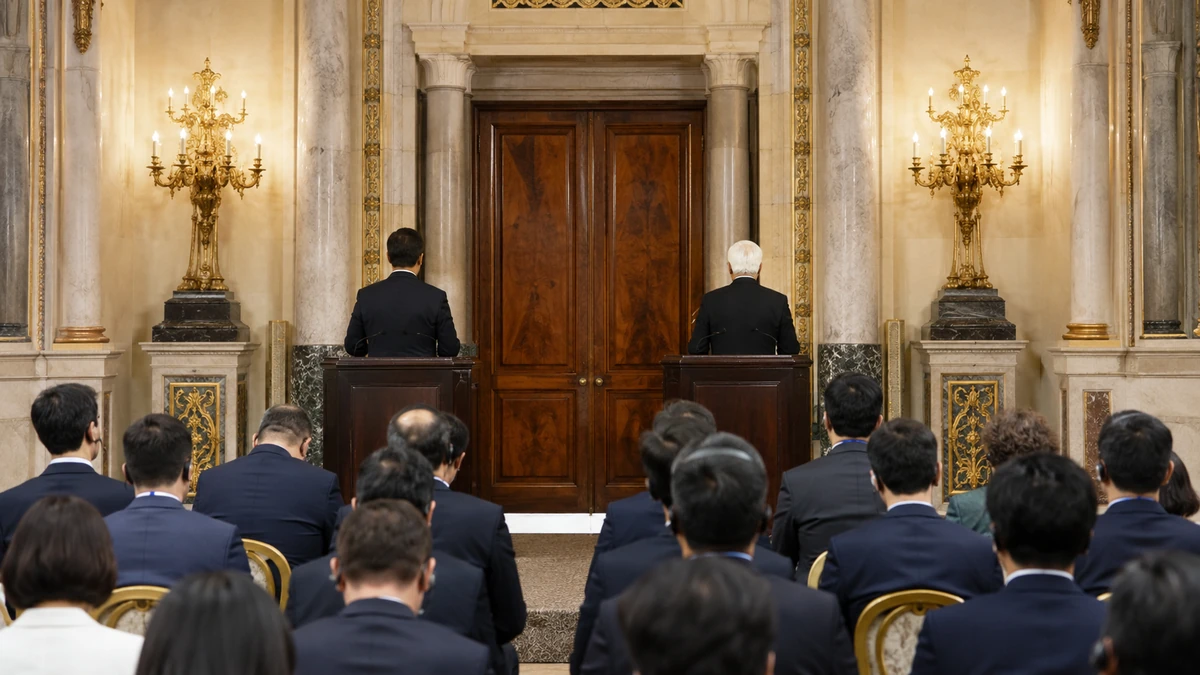
President Lee Jae-myung used a rare state visit to Italy this week to send a broader message about where South Korean diplomacy is headed: deeper ties with Europe, built not only on culture and trade but on the hard-edged priorities shaping global politics today — artificial intelligence, defense manufacturing and space cooperation.
After talks Thursday in Rome with Italian President Sergio Mattarella, Lee said South Korea and Italy would work to elevate their relationship into what Seoul calls a “special strategic partnership,” while expanding cooperation in a trio of sectors that increasingly define national power. According to South Korean officials and remarks carried by Yonhap, Lee also pointed to a planned 2026-2030 bilateral action plan designed to give that partnership a longer time horizon and a more formal structure.
For American readers, the scene may sound ceremonial at first glance: a foreign leader welcomed at a presidential palace, a joint appearance before reporters, a carefully worded statement about friendship and shared prosperity. But in diplomacy, the ceremony is often part of the policy. The format matters. The location matters. The title of the visit matters. And in this case, Lee’s status as a state guest — the first such visit by a South Korean president to Italy in 26 years, according to his remarks — was itself part of the message.
State visits are not everyday meetings squeezed in on the sidelines of a summit. They are among the highest forms of diplomatic recognition one country can offer another. In Washington terms, think of the difference between a brief handshake at the United Nations and a full state dinner at the White House. The substance of the relationship may develop over years, but the symbolism tells both domestic and international audiences that the relationship deserves a bigger frame.
That appears to be exactly what Seoul wanted. Lee’s comments, as summarized by South Korean media, went beyond celebrating a long-standing friendship. He tied that history to a more practical agenda: using accumulated trust to build structured cooperation in industries that sit at the crossroads of economic competitiveness, security policy and national prestige.
For South Korea, which has spent the last two decades transforming itself from a manufacturing powerhouse into a technology and cultural heavyweight, Europe is increasingly more than just an export market. It is also a strategic arena. This visit suggests Seoul wants to be seen not simply as an Asian middle power with a strong consumer brand, but as a country capable of shaping the next phase of transcontinental partnerships.
Why Italy matters to South Korea now
Italy is not always the first European country Americans think of in Asian diplomacy. Germany tends to dominate conversations about industrial policy, France about defense and strategic autonomy, and the United Kingdom about security alliances and finance. But Italy brings a combination of political stature, advanced manufacturing and defense-industrial capability that makes it an important partner for a country like South Korea.
Rome is a major member of the European Union, the Group of Seven and NATO. It has global diplomatic reach, a sophisticated industrial base and a long history of participation in aerospace and defense projects. For Seoul, a closer relationship with Italy offers more than bilateral value. It also provides an additional channel into broader European conversations about technology governance, supply chains, industrial resilience and security cooperation.
That matters because South Korea’s foreign policy is increasingly shaped by a difficult reality: the world is no longer organized around neat boundaries between economics and security. Semiconductors, batteries, AI systems, missile defense, launch capabilities and critical materials all sit in the same strategic conversation. Countries that want influence have to show they can operate across those categories.
South Korea has been moving in that direction for years. It already has a reputation in the United States and elsewhere as a formidable producer of advanced consumer electronics, automobiles, ships and memory chips. More recently, it has also raised its profile as a defense exporter, with Korean-made systems drawing attention in Europe and beyond. At the same time, Seoul has sought to position itself as a serious player in emerging technologies, including AI, while investing more heavily in its space ambitions.
Against that backdrop, Lee’s message in Rome reads less like a one-off diplomatic flourish and more like a chapter in a larger strategy. The point was not simply that South Korea and Italy get along. The point was that their relationship can be upgraded into one suited to the strategic demands of the 2020s and 2030s.
That distinction is important. Governments often talk about friendship. They use language about shared values, mutual respect and long histories of exchange. But when leaders start naming sectors like AI, defense and space in the same breath, they are usually signaling something more concrete: that the relationship is being redefined around capabilities, trust and long-term alignment.
From 142 years of ties to a future-focused partnership
Lee framed the moment in historic terms, saying the two countries’ 142 years of trust had widened the horizon for cooperation. That kind of language is common in diplomacy, but it serves a real purpose. History, when invoked this way, is not just nostalgia. It is a form of political capital. Leaders use it to argue that a deeper partnership is not a gamble but a logical extension of a relationship that has already proved durable.
For American audiences, it may help to think of this as the diplomatic equivalent of a company pointing to decades of successful collaboration before announcing a major joint venture. The past does not guarantee the future, but it lowers the perceived risk of doing more together.
Lee went a step further by linking that history to “co-prosperity,” a phrase often used in East Asian diplomatic language to emphasize mutual benefit rather than zero-sum gain. In practical terms, he appeared to be arguing that old ties should now generate new, measurable outcomes. That is a subtle but important shift. Longstanding goodwill can help set the mood, but governments are under pressure to show that high-level diplomacy leads to something more tangible than photo opportunities.
That pressure is especially strong in South Korea, where foreign policy is often evaluated not only in geopolitical terms but in terms of economic opportunity, industrial strategy and national status. South Koreans are acutely aware that their country has risen dramatically on the world stage in a relatively short period of time. The Korean Wave — known as Hallyu, the global spread of Korean pop culture including K-pop, television dramas and film — has amplified that visibility. But Korean officials do not want the country understood only through cultural exports.
In recent years, Seoul has worked to pair soft power with strategic weight. The same country that exports BTS, “Parasite” and Netflix-ready dramas also wants recognition for exporting artillery systems, building launch vehicles, developing AI capabilities and helping shape global technology standards. Lee’s comments in Italy fit squarely into that effort.
Put differently, this is part of South Korea’s long-running attempt to tell the world a fuller story about itself. Yes, it is a cultural powerhouse. Yes, it is a democratic ally of the United States. But it is also trying to present itself as a country with the institutional capacity, technical depth and strategic ambition to partner with major powers on the industries of the future.
Why AI, defense and space are grouped together
At first glance, artificial intelligence, defense manufacturing and space cooperation may seem like three separate files on a policymaker’s desk. In reality, they increasingly belong to the same folder.
AI is not just a Silicon Valley buzzword or a consumer technology story. It is rapidly becoming a core element of national competitiveness, touching everything from factory automation and logistics to military analysis, cyber defense and scientific research. Any country that wants to remain near the front edge of advanced industry now has to think seriously about AI partnerships.
Defense cooperation, meanwhile, carries weight far beyond military procurement. It reflects trust, interoperability and industrial credibility. When countries talk about working together in defense, they are also talking about supply chains, research capacity, training, regulation and long-term political alignment. For South Korea, whose defense sector has won growing international attention, this is an area where diplomacy and industry naturally reinforce each other.
Space may sound more futuristic, but it is no longer an elite prestige project detached from daily life. Space capabilities now connect to communications, earth observation, navigation, climate monitoring, disaster response and dual-use technologies that can support both civilian and security needs. In other words, space is a strategic ecosystem, not just a scientific ambition.
That is why these three fields make sense together. Each one signals modern state capacity. Each one requires a mix of capital, technical talent and political trust. And each one allows governments to tell voters and investors that they are preparing for the future rather than just managing the present.
For Seoul, there is another advantage in bundling them. Doing so casts South Korea not as a niche player with expertise in only one domain, but as a multidimensional partner. It suggests that when South Korea approaches Europe, it is not merely selling products or seeking symbolic support. It is offering participation in a broader strategic relationship anchored in advanced capabilities.
The Korean summary of Lee’s remarks does not provide a long list of specific projects, and it is important not to overstate what has been formally agreed. But even without a detailed package of deals, the public naming of these sectors at the presidential level matters. In diplomacy, what leaders choose to spotlight often reveals the direction bureaucracies and industries will be encouraged to follow.
What “special strategic partnership” means — and what it does not
One of the most notable phrases in Lee’s remarks was his call to develop South Korea’s relationship with Italy into a “special strategic partnership.” That kind of label can sound vague to outsiders, and in fairness, diplomatic titles do not always come with instantly clear definitions. They are not the same as treaty language, and they do not necessarily mean a dramatic policy shift happens overnight.
Still, such terminology matters. In international relations, the name assigned to a relationship often serves as both a signal and a framework. It tells diplomats, ministries and business communities that the political leadership wants the connection treated as broader, more structured and more consequential than an ordinary friendly relationship.
Think of it as a way of upgrading the relationship’s operating system. The phrase alone does not create policy outcomes, but it changes expectations about the level of engagement, the range of topics under discussion and the seriousness with which both sides may pursue follow-through.
It also matters that this was announced in the setting of a state visit and paired with the mention of a strategic action plan covering 2026 to 2030. That combination suggests the South Korean side wants to avoid the common diplomatic problem of grand language without continuity. By pointing to a multi-year framework and emphasizing that cooperation will be reviewed over time, Lee signaled an interest in turning headline language into a management structure.
There is a practical logic here. Advanced cooperation in AI, defense or space cannot be built through one summit alone. It requires sustained bureaucratic work, legal coordination, industrial consultation and repeated political attention. A multi-year action plan can serve as a container for that work, even if the specifics are filled in later.
At the same time, caution is warranted. Based on the information available in the Korean summary, this appears to be an announcement of direction rather than a fully transparent catalog of binding commitments. That distinction matters in journalism. It is fair to say Seoul and Rome are describing the relationship in more strategic terms. It would be premature to claim every mechanism or project is already locked in place.
But diplomacy often begins with a shift in framing before it produces visible outputs. In that sense, the phrase itself is part of the story.
South Korea’s European playbook comes into focus
What happened in Rome also sheds light on a larger trend in South Korean foreign policy: the effort to broaden the country’s strategic footprint beyond the Indo-Pacific without abandoning its core regional priorities.
South Korea remains deeply shaped by its immediate neighborhood — the threat from North Korea, the rise of China, the importance of Japan, and its alliance with the United States. None of that has changed. But Seoul increasingly understands that its national interests are also influenced by decisions made in Brussels, Rome, Berlin, Paris and London.
European countries matter to South Korea not just as trade partners, but as rule-makers, technology regulators, defense actors and diplomatic stakeholders in a fragmented global system. As the world becomes more multipolar and more economically securitized, middle and major powers alike are trying to diversify their partnerships. South Korea is no exception.
For Americans, there is a familiar analogy here. Just as Washington has spent years urging allies and partners to think across regions rather than inside silos, Seoul appears to be doing more of the same. It is seeking relationships that are not limited to one issue or one geography. A stronger tie with Italy can therefore be understood not only as a bilateral move, but as part of a wider Korean effort to build density in Europe.
That matters because diplomacy in the 21st century often rewards network strength. Countries that can connect across multiple sectors and multiple regions are better positioned to absorb shocks, shape standards and pursue their interests without overreliance on any single partner. South Korea’s outreach to Italy, particularly in strategic industries, fits this network-building logic.
It also suggests that Seoul sees Europe as a place where its own evolution can be recognized. South Korea no longer wants to be treated primarily as a manufacturing subcontractor, a frontline security state or a pop-culture phenomenon. It wants acknowledgment as a sophisticated strategic actor. Partnerships with influential European capitals help reinforce that identity.
What comes next — and why ordinary people should care
Lee said he hoped the visit would open a new road to shared prosperity and lead to practical changes in people’s lives. That is the kind of line world leaders often use, and skeptics may reasonably ask what ordinary citizens in South Korea or Italy are supposed to do with talk of AI, defense and space.
The answer depends on whether the diplomatic architecture announced this week produces real follow-through. If it does, the effects could be felt in more concrete ways than summit language suggests. Cooperation in AI can shape investment, research opportunities, workplace modernization and regulatory alignment. Defense ties can affect industrial jobs, export opportunities and technological spillovers. Space partnerships can influence scientific collaboration, communications infrastructure and high-end manufacturing.
Even so, the public case for such diplomacy has to be made carefully. In democracies, leaders cannot assume that voters will automatically rally around abstract strategic concepts. They need to connect geopolitical initiatives to recognizable benefits — innovation, employment, security, resilience and a stronger place in the global economy.
That is likely why Lee’s messaging emphasized both grand strategy and everyday impact. South Korea, like many U.S. allies, is navigating an era in which diplomacy must justify itself not just to foreign governments but to domestic audiences who are more skeptical, more economically anxious and more alert to questions of national return on investment.
For now, the meeting in Rome is best understood as a marker rather than a finale. It marks South Korea’s intention to deepen ties with a major European partner through a more strategic lens. It marks an effort to transform a long historical relationship into a forward-looking one. And it marks the continued expansion of South Korea’s global profile beyond the cultural influence that first made many American audiences pay attention.
If the last decade introduced much of the world to South Korea through music, film, television and food, the next decade may be increasingly defined by whether Seoul can translate that visibility into durable geopolitical and technological influence. In Rome this week, Lee made clear that South Korea intends to try.
Comments
Post a Comment