
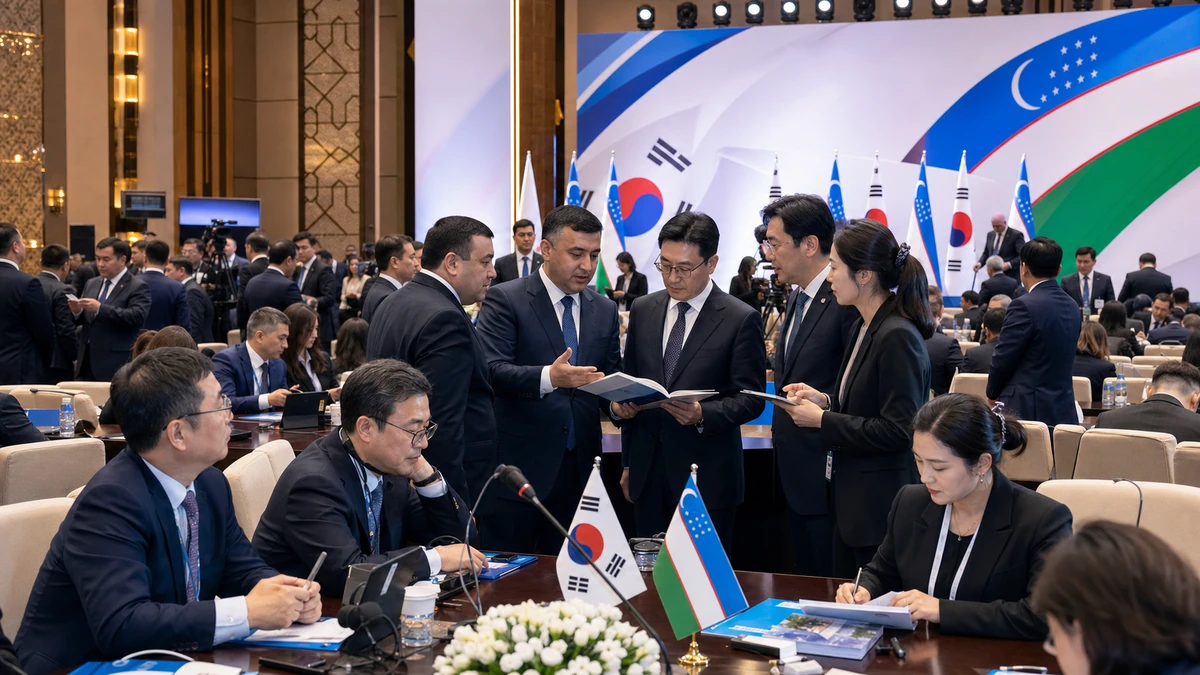
Why an Investment Forum in Tashkent Matters Beyond the Region
Uzbekistan’s latest pitch to foreign investors may sound, at first glance, like the kind of routine economic summit that rarely travels far beyond business pages. But the Tashkent International Investment Forum, which opened this week in the Uzbek capital, points to something larger: a country of nearly 37 million people trying to reposition itself as the commercial crossroads of Central Asia, and a new opening for South Korean companies looking beyond their traditional overseas markets.
According to the South Korean news agency Yonhap, Uzbekistan is treating foreign investment as a central pillar of its national growth strategy and is actively highlighting deeper economic cooperation with South Korea. That message was reinforced by a Korea-Uzbekistan business forum held in Tashkent on June 16, an event that underscored a shift from diplomatic symbolism to practical deal-making, networking and long-term market positioning.
For American readers, the easiest comparison may be to the way countries court global capital at gatherings like the World Economic Forum in Davos, or how states in the U.S. compete to lure factories, data centers or semiconductor plants with promises of streamlined regulation, infrastructure and political support. Uzbekistan is attempting something similar on a national scale, selling itself as a stable entry point into a region that has often been discussed more in terms of geopolitics than commerce.
That matters not only to Seoul and Tashkent, but to a wider international audience. South Korea has become one of the world’s most outward-looking economies, with companies that have already established global reputations in manufacturing, construction, electronics, batteries, automobiles and logistics. If those firms are now seriously eyeing Central Asia, it suggests the region is moving from the periphery of Asian business strategy toward a more meaningful place on the map.
It also reflects a broader reality of the post-pandemic global economy: companies and governments alike are looking for new supply chains, new consumer markets and new strategic footholds. In that search, Uzbekistan is making the case that it should no longer be seen simply as a former Soviet republic with a difficult geography, but as an emerging investment platform between Europe and Asia.
Uzbekistan’s Long Game: Becoming Central Asia’s Economic Hub
Uzbekistan’s message at the investment forum is straightforward. The country wants to become an economic center of gravity in Central Asia, and it believes foreign capital is essential to making that happen. That is an ambitious goal in a region better known to many Americans through the lens of great-power rivalry, energy politics and the old Silk Road than through day-to-day business news.
Central Asia, which includes Kazakhstan, Uzbekistan, Kyrgyzstan, Tajikistan and Turkmenistan, sits in a strategically significant location between China, Russia, the Middle East and Europe. Its geography has always suggested commercial potential. But geography alone does not make a market. Investors also want regulatory clarity, predictable administration, legal protections and enough openness to make long-term planning worthwhile.
That is the challenge Uzbekistan appears to be trying to answer. Yonhap’s summary of the Korean coverage says the Uzbek government has been easing regulations and opening parts of its market to foreign investors. In plain terms, that means trying to lower the barriers that often discourage outside companies from entering emerging markets: opaque rules, sudden policy shifts, bureaucratic delays and uncertainty about how laws are enforced in practice.
For global business, those concerns are not abstract. A company considering a new manufacturing facility, logistics partnership or infrastructure investment is not just asking whether there is growth potential. It is asking whether permits will be granted on time, whether contracts will be honored, whether currency and financing risks can be managed, and whether there is a workable relationship between state policy and private enterprise.
Uzbekistan’s effort to host an international investment forum is therefore about more than branding. It is a formal signal to outside investors that the government wants to be judged as a serious economic player. These forums function as public stages where countries present not just projects, but a narrative: We are open for business, our rules are becoming more investor-friendly, and we are prepared to compete for your money and expertise.
That narrative is especially important in Central Asia, where each country has distinct political systems, regulatory traditions and commercial environments. By leaning aggressively into investment promotion, Uzbekistan is trying to distinguish itself inside the region as the place where foreign firms can enter with fewer unknowns and more institutional support.
Why South Korea Is Paying Attention
The Korean angle here is critical. South Korea is not just another potential investor. It is one of Asia’s most sophisticated export economies and a country with long experience building commercial partnerships in difficult or developing markets. From heavy industry and shipbuilding to semiconductors and consumer brands, South Korean firms have spent decades learning how to scale abroad.
That experience gives Seoul a particular interest in countries like Uzbekistan, which are trying to industrialize, modernize infrastructure and attract outside expertise. The Korea-Uzbekistan business forum in Tashkent suggests the relationship is moving beyond government-to-government ceremony and into a space where companies, financiers and trade officials are looking for concrete opportunities.
For American audiences, South Korea’s business culture may be familiar through brands like Samsung, Hyundai, LG and Kia. But the country’s global reach goes far beyond household names. Korean firms are deeply involved in engineering, chemicals, construction, energy systems, transportation and digital infrastructure. In many parts of the world, Korean companies are viewed as attractive partners because they combine advanced industrial know-how with experience operating in fast-changing growth markets.
That matters in Uzbekistan, where the next phase of development may require more than simple trade. It may require industrial partnerships, financing structures, logistics planning, project management and the ability to work within a changing regulatory environment. Those are areas where Korean firms often have a competitive edge.
The political relationship also helps. The Korean summary describes Uzbekistan as a key South Korean partner in Central Asia. In international business, familiarity and accumulated trust matter almost as much as raw market size. Companies entering a new country are not just evaluating consumers and infrastructure; they are also evaluating the quality of communication between institutions, the reliability of policy dialogue and the track record of prior cooperation.
None of that guarantees success. But it does mean South Korean firms are likely to view Uzbekistan not as a speculative curiosity, but as a market worth serious study. And in global commerce, getting onto that shortlist is often the first meaningful step.
What Market Opening and Deregulation Actually Mean for Investors
One of the most important points in the Korean reporting is also one of the easiest to overstate. Uzbekistan has been emphasizing market opening and regulatory easing, but that should not be confused with a promise that investment will automatically flow or that every foreign entrant will prosper.
When officials talk about deregulation or a more open market, investors tend to break that down into practical questions. Can a foreign company fully own a local operation? How difficult is it to move capital in and out of the country? How transparent are tax rules? How predictable are customs procedures? How long does it take to register a business, lease land, import equipment or hire skilled workers? Are there functioning dispute-resolution mechanisms if things go wrong?
Those details rarely make headlines, but they determine whether a country’s investment story is persuasive or merely aspirational. That is true whether the location is Uzbekistan, Vietnam, Mexico or an American state trying to attract an electric vehicle plant. Businesses can work with risk. What they dislike most is uncertainty they cannot model.
From that perspective, Uzbekistan’s message is significant even if there are no blockbuster deals to announce yet. The country is publicly defining foreign investment not as a side issue, but as a national development priority. That matters because it signals continuity of intent. Investors generally look for countries where policy changes are not one-off announcements, but part of a sustained strategy.
There is also a cumulative effect. A single reform may not transform a business climate. But a series of reforms — easier market entry, fewer administrative bottlenecks, clearer investment rules, stronger financial infrastructure — can gradually change how companies rank a market. A place once seen as too difficult can become a plausible medium-term bet.
For South Korean firms, this is especially relevant. Korean companies often succeed overseas not simply because of product quality, but because they are adept at building business models around local conditions. If Uzbekistan is lowering the entry cost and reducing institutional uncertainty, that expands the strategic room for Korean investors to design projects tailored to local demand and regional trade routes.
Still, caution is warranted. The information currently available points to an evolving opportunity, not a completed breakthrough. A forum can showcase intent, but implementation is what ultimately shapes investor confidence. The real test will be whether liberalization is sustained, whether institutions follow through, and whether businesses on the ground experience the promised ease of entry and operation.
The Tashkent Finance Hub Idea and Why It Sends a Bigger Signal
One of the more intriguing elements in the Korean summary is Uzbekistan’s plan to establish the Tashkent International Financial Center, described as a special international financial zone intended to attract overseas capital and financial services. Even without a detailed timetable or formal institutional blueprint, the idea itself is revealing.
It suggests Uzbekistan does not want foreign investment to be limited to factories, commodity extraction or straightforward trade. It wants to build a broader investment ecosystem — one that includes financing, payments, risk management and possibly specialized legal or regulatory frameworks designed to support cross-border commerce.
For readers in the U.S., it may help to think of this as an attempt to create part of the underlying architecture that makes business expansion possible. Companies do not operate on industrial policy alone. They need banking channels, investment vehicles, currency solutions, legal structures and mechanisms for managing commercial risk. A financial center is meant to provide at least some of that scaffolding.
There are many examples around the world of governments trying to create specialized zones to attract international business, from the Dubai International Financial Centre to the Astana International Financial Centre in neighboring Kazakhstan. Not all such projects succeed at the same scale, but they share a common logic: make it easier and more attractive for foreign capital to function inside the domestic economy.
For South Korea, this is more than an abstract policy development. Korean overseas expansion is no longer defined only by exporting finished goods. It increasingly involves joint ventures, local financing, long-horizon infrastructure partnerships and integrated supply chain planning. If Uzbekistan is serious about strengthening its financial infrastructure, that could create more favorable conditions for Korean firms that want to establish a durable local presence rather than simply sell into the market from afar.
It also hints at Uzbekistan’s sense of competition. To become a true regional platform, a country cannot rely solely on geography or low-cost labor. It needs institutions that help money move, projects get financed and partnerships scale. By floating the idea of an international financial center, Uzbekistan is signaling that it understands the competition for foreign capital is as much institutional as it is geographic.
A New Map for Korean Business — and a Story the World Should Watch
The bigger story here is not a single business forum or one country’s investment pitch. It is the steady expansion of South Korea’s commercial horizon and the possibility that Central Asia, long discussed as a strategic buffer zone, is beginning to emerge as a real arena for Asian corporate growth.
For years, the overseas map for Korean business has been dominated by East Asia, North America, Europe and, increasingly, Southeast Asia. Those regions remain central. But the Tashkent events suggest Korean policymakers and businesses are also paying closer attention to markets that sit outside the usual headlines yet offer long-term strategic value.
That is a meaningful development in its own right. Central Asia offers a different kind of opportunity: not necessarily the immediate scale of the U.S. or China, but the chance to enter a market during a period when its rules, institutions and international economic relationships are still being shaped. For some companies, that kind of timing can be valuable. Early movers can build influence, local partnerships and brand recognition before competition becomes more crowded.
There is a broader global dimension as well. International investors have been rethinking concentration risk, supply chain dependence and geopolitical exposure. In that context, middle markets and frontier-growth regions have become more important. Countries that can offer political intent, reform momentum and a compelling regional role can attract attention even if they are not yet major consumer destinations.
Uzbekistan appears to be trying to seize that moment. By promoting openness, reducing regulatory barriers and aligning itself with internationally active partners like South Korea, it is attempting to recast its image from distant landlocked state to emerging commercial connector.
For American readers, the relevance may not be obvious at first, but it should be. This is the kind of development that often foreshadows future changes in trade flows, infrastructure investment and regional influence. When South Korean business begins looking seriously at a market, it is often because executives see more than cheap labor or diplomatic goodwill. They see industrial logic, policy movement and strategic timing.
That does not mean a wave of transformational deals is already underway. The facts currently available are more modest and more important in their own way. Uzbekistan is making a concentrated effort to attract foreign investment. It is using the Tashkent International Investment Forum and the Korea-Uzbekistan business forum to signal openness and partnership. It is presenting itself as a more accessible and institutionally prepared destination for outside capital. And South Korea is being openly courted as part of that effort.
In economic journalism, the challenge is often separating what has happened from what may happen next. So far, what has happened is a clear articulation of strategy. What may happen next is a deeper alignment between Uzbekistan’s push for international capital and South Korea’s search for new frontiers of growth.
That is why this story deserves attention beyond Seoul or Tashkent. It captures a larger shift in the world economy, one in which emerging regions are competing harder for capital, middle powers are widening their commercial reach, and the geography of growth is becoming more varied than the familiar corridors linking the United States, Europe and East Asia. Uzbekistan wants a bigger place in that map. South Korea may prove to be one of the countries helping it get there.
What Comes Next: Promise, Limits and the Need for Follow-Through
The most responsible way to read the moment is with a mix of interest and restraint. There is not yet evidence, based on the summary now available, of major signed contracts or finalized large-scale projects that would instantly redefine Korea-Uzbekistan economic ties. That distinction matters. Investment forums are designed to generate momentum, but momentum is not the same thing as execution.
Still, momentum matters. It shapes boardroom discussions, encourages exploratory visits, prompts feasibility studies and raises a country’s profile among investors who may previously have overlooked it. In that sense, Uzbekistan may already have accomplished something valuable simply by putting itself more firmly into the field of vision of South Korean industry and international capital.
The next phase will depend on follow-through. Investors will watch whether reforms continue, whether institutions become easier to navigate and whether the country can translate its strategic messaging into operational confidence. They will also watch whether the proposed financial center evolves into a credible mechanism rather than remaining a concept on paper.
For South Korean companies, the calculation is likely to be pragmatic. They are unlikely to treat Uzbekistan as a replacement for larger established markets. But they may increasingly treat it as a strategic addition — a place to test regional expansion, secure partnerships and position themselves in a part of the world whose economic importance could grow over time.
For the rest of the world, including American businesses and policymakers, the lesson is simple. Central Asia is no longer just a geopolitical chessboard. It is increasingly a commercial arena, and Uzbekistan is trying to make itself one of its main gateways. When that effort begins to intersect with the ambitions of globally competitive South Korean firms, it becomes a story not only about bilateral relations, but about how the next map of economic opportunity is being drawn.


0 Comments