South Korea issues its first top-tier heat alert of the year, warning of deadly risk for older adults
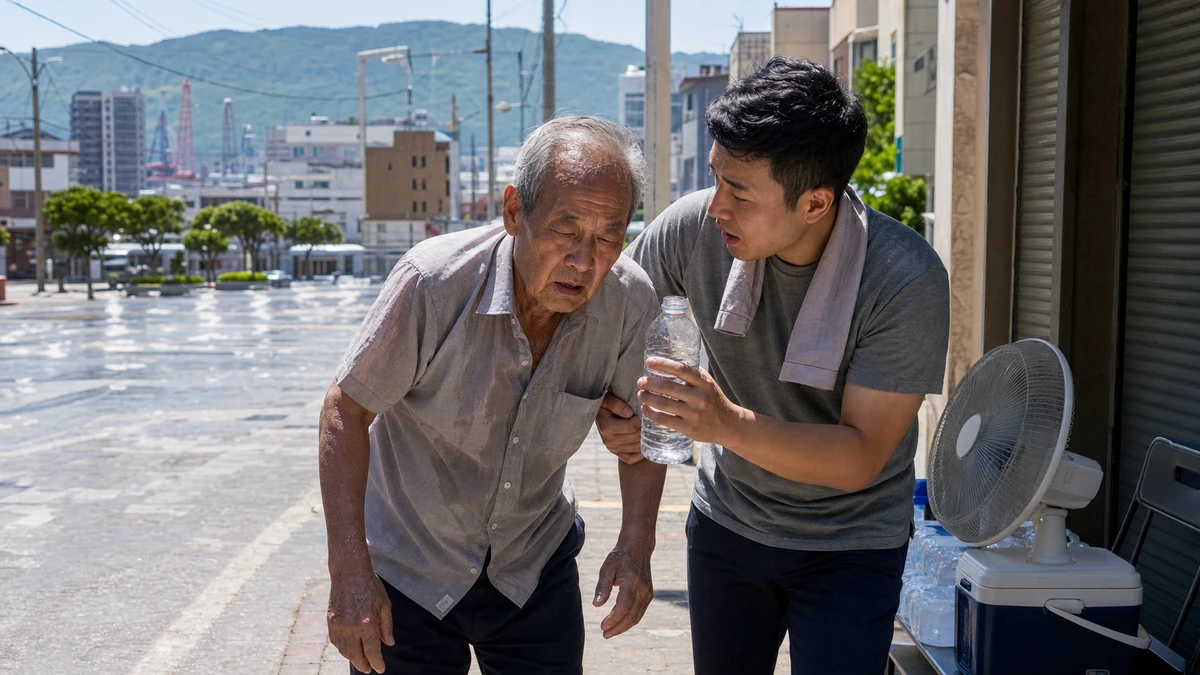
South Korea’s hottest warning level arrives early in the day
South Korean authorities on Saturday issued the country’s first top-tier extreme heat alert of the year for the southeastern cities of Gyeongsan and Pohang, a sign that the summer heat now gripping the country has moved beyond discomfort and into a more dangerous phase.
The alert took effect at 10 a.m., according to South Korean officials, and that timing matters. In practical terms, it means residents were being told before midday not merely to brace for a hot afternoon, but to change plans immediately: stop unnecessary outdoor activity, move into air-conditioned spaces or designated cooling shelters, drink water and rest. For older adults in particular, officials framed the warning as a health threat, not just a weather update.
The benchmark behind the alert is a “feels like” temperature of 100.4 degrees Fahrenheit, or 38 degrees Celsius. South Korea’s weather agency uses apparent temperature — similar to the heat index familiar to Americans — to reflect the temperature people actually experience once humidity and surrounding conditions are factored in. Anyone who has lived through a sticky July in Washington, Houston or Miami knows that the number on the thermometer can understate the danger. A day that reads one way on paper can feel much more punishing on the body.
What makes this alert especially striking is the public health language attached to it. South Korean officials said that when the apparent temperature reaches 38 degrees Celsius or higher, the risk of death for adults 65 and older can rise by 19 percent. That does not mean every older person faces the same outcome, or that heat alone determines what happens in a specific case. It does mean that for an aging population, extreme heat sharply raises the odds of serious harm.
In a country where summer heat has become a recurring test of infrastructure, public health preparedness and social cohesion, the first severe heat alert of the season often serves as a wake-up call. Saturday’s warning did exactly that, especially because it was issued in regions already dealing with sustained, nationwide heat.
Why Gyeongsan and Pohang matter
To many readers outside Korea, Gyeongsan and Pohang may not be household names, so some context helps. Both cities are in North Gyeongsang province, in South Korea’s southeast. Pohang is a coastal industrial city known for steelmaking and port activity. Gyeongsan, located inland near the larger city of Daegu, is part of a densely connected urban and suburban zone where people commute, study and work across municipal boundaries.
That geography matters because southeastern Korea is no stranger to brutal summer weather. Daegu, one of the region’s largest cities, is often compared to inland American cities that trap summer heat, though Korea’s humidity can make conditions feel even more oppressive. On Friday, the day before the top-tier alert was issued for Gyeongsan and Pohang, a heat warning was already in effect in Daegu. News images from the city showed heat shimmering off roads, the kind of mirage-like distortion Americans might recognize from highways baking under a Southwest sun.
But visible heat on pavement is only part of the story. Modern heat warnings increasingly focus on what prolonged exposure does to the human body, especially for people who are older, have chronic illnesses, work outside, or live without reliable access to cooling. South Korea’s alert system reflects that shift. The warning issued for Gyeongsan and Pohang was not based on a single hot afternoon. It is triggered when an area has already experienced at least two days with a daily maximum apparent temperature of 35 degrees Celsius, or 95 degrees Fahrenheit, and is then expected to reach an apparent temperature of 38 degrees Celsius or an air temperature of 39 degrees Celsius, about 102.2 degrees Fahrenheit, for at least one day.
That standard shows the alert is designed for cumulative danger, not just a headline-grabbing peak. For Americans, the closest analogy may be the growing emphasis by the National Weather Service and local health departments on multi-day heat events, when the body has little opportunity to recover overnight and the risk compounds with each passing day.
A warning shaped by an aging society
The most urgent message in Saturday’s alert concerns older adults. South Korea is one of the world’s fastest-aging societies, with a rapidly growing share of residents over 65 and many older people living alone or spending long hours in routines that may not seem risky until weather conditions turn severe. A walk to a market, time spent tending a garden, waiting at an outdoor bus stop, or performing light work outside can become dangerous much faster than people expect.
That is why officials have emphasized that a severe heat alert is not an abstract caution to “be careful.” It is a call for immediate behavioral change. If the heat index reaches the top warning level, authorities want older adults and the people around them to stop outdoor activity, move somewhere safer and check on one another. In the Korean guidance, the message is summarized in three plain actions: stop, move and check.
Those instructions may sound simple, but they capture a broader lesson that public health agencies around the world have learned through repeated heat disasters: survival often depends less on knowing the exact forecast than on acting quickly and early. In the United States, officials make similar appeals during heat emergencies, urging people to use cooling centers, stay hydrated and check on elderly neighbors. The difference in South Korea is that these instructions are increasingly woven into a national response system that explicitly links weather thresholds to vulnerable populations.
The 19 percent figure cited for people 65 and older gives the alert moral weight as well as scientific clarity. It tells families, employers, neighbors and local governments that this is not merely a matter of summer inconvenience. When weather agencies warn of life-threatening heat, the burden does not fall only on the individual. It falls on communities to notice who is still working outside, who may not have air conditioning, who may be reluctant to ask for help, and who may downplay their own risk out of habit or pride.
In both Korea and the United States, older adults are often the people least likely to describe themselves as vulnerable. Many have lived through harsher times and are used to pushing through discomfort. But extreme heat is deceptive. It can overwhelm the body before someone fully recognizes what is happening, and it can do so especially fast when humidity remains high and recovery time is limited.
How Korea’s heat response works on the ground
South Korea’s official response guidance during a severe heat alert is practical and direct. Residents are urged to suspend outdoor activity as much as possible, move to cooling shelters, shaded areas or air-conditioned buildings, drink enough fluids and rest. Just as important, they are told to check the condition of those around them.
Cooling shelters are a notable feature of the Korean response system. Local governments commonly designate air-conditioned public spaces where residents can escape dangerous temperatures during heat waves. For American readers, they are broadly similar to cooling centers opened in libraries, recreation centers, senior facilities or municipal buildings during extreme heat events. In Korea, these shelters can be especially important for older adults, lower-income residents and people in older housing stock that may be less able to keep indoor temperatures safe during sustained heat.
The alert’s 10 a.m. issuance underscores another point: authorities are trying to interrupt the normal rhythm of the day before dangerous exposure continues. Someone who has already left home for errands, farm work, construction, delivery work or exercise may feel pressure to finish what they started. The official guidance argues against that instinct. The message is to change course as soon as the severe alert is issued, not after symptoms develop and not after “just one more task.”
Public health experts have long warned that heat illness can be easy to underestimate because it does not arrive with the dramatic visuals of a typhoon, flood or wildfire. There may be no visible destruction, no broken buildings and no plume of smoke. Instead, the threat often unfolds quietly — in dehydration, dizziness, confusion, exhaustion, collapse and cardiovascular strain. That is part of why officials repeat the basics so insistently. Water, shade, air conditioning and rest may sound mundane, but they remain among the most effective tools available.
South Korea’s disease control authorities also reminded the public to follow heat illness prevention measures as the first severe heat alert of the year took effect. The emphasis on hydration and rest may appear obvious, but health officials repeatedly stress that brief or partial measures are not enough. Drinking a little water while staying in direct heat, for example, is not the same as fully removing oneself from a dangerous environment, cooling down and recovering.
Heat, work and the limits of assumption
The danger of extreme heat extends beyond retirees and people at home. Workers in agriculture, construction, logistics, manufacturing yards and livestock facilities are also exposed, sometimes for long stretches and sometimes under economic pressure to keep going.
That broader concern surfaced in a separate incident reported from South Chungcheong province, where a Nepalese worker in his 30s was found collapsed Friday evening at a livestock facility in Hongseong County and taken to a nearby hospital in cardiac arrest, according to officials. But authorities have not determined that heat caused the collapse, and it would be irresponsible to say that it did. Fire officials said there was an abrasion on the worker’s forehead and that whether he suffered a heat-related illness remained under investigation.
That distinction matters. In fast-moving weather coverage, there is often pressure to connect every medical emergency during a heat wave directly to the heat itself. Sometimes that proves accurate. Sometimes it does not. Good reporting — and responsible public communication — requires restraint until facts are established.
Still, the case illustrates why officials are so forceful when warning against prolonged exposure in severe conditions. Whether someone is elderly, middle-aged or younger, outdoor or semi-outdoor work can become hazardous quickly when apparent temperatures soar. And in many jobs, the risk is compounded by physical exertion, limited shade, protective clothing, machinery heat and the social pressure not to stop. In the United States, labor advocates and safety regulators have raised similar alarms as extreme heat becomes a more common workplace hazard from California farm fields to Texas construction sites.
South Korea’s current heat warning therefore speaks to more than residential safety. It points to questions of labor protection, employer responsibility and emergency readiness. When official guidance says “stop, move and check,” that message applies not just to families caring for older relatives, but also to supervisors, coworkers and local officials who have the authority to pause dangerous activity and move people to safer conditions.
What this moment says about Korea’s summers now
Saturday’s alert in Gyeongsan and Pohang is specific to two cities, but the implications are national. Korea is in the middle of broader summer heat, and these cities simply reached the severe threshold first. That makes them an early indicator of what other regions could face if temperatures and humidity remain high.
In that sense, the warning functions much like the first major heat emergency of the season in the United States. It forces people to reacquaint themselves with a familiar but often underappreciated danger. Each year, extreme heat kills more people in the United States than many other weather hazards, even though it rarely commands the same dramatic attention as hurricanes or tornadoes. South Korea is confronting a parallel reality: heat is not a side story to summer. It is one of summer’s central public safety challenges.
There is also a cultural dimension. In Korea, as in many societies, older family members may prefer not to be fussed over, and younger relatives may assume a parent or grandparent who has always handled summer fine will continue to do so. But as the climate grows more volatile and heat events intensify, those assumptions become riskier. A weather alert that explicitly identifies adults 65 and older as facing elevated mortality risk is effectively asking families to replace habit with vigilance.
For people unfamiliar with Korea’s local systems, one important takeaway is that heat safety there is increasingly community-based. The expectation is not merely that individuals watch the forecast, but that neighbors, relatives and coworkers actively confirm whether vulnerable people are safe. That social dimension may feel especially resonant in a country where dense urban living, multigenerational family ties and local government response structures often intersect.
Another takeaway is that “feels like” temperature deserves to be taken seriously. Americans often debate whether dry heat or humid heat is worse, but from a public health standpoint the meaningful question is how much thermal stress the body is actually under. South Korea’s reliance on apparent temperature reflects an effort to communicate risk in human terms rather than just meteorological ones.
The simplest advice is still the most important
If there is one lesson from South Korea’s first severe heat alert of the year, it is that extreme heat demands action before visible crisis sets in. By the time a person feels truly overwhelmed, the safest window for prevention may already be narrowing.
Authorities in Korea are telling residents of Gyeongsan and Pohang to do something very straightforward: cancel or delay unnecessary outdoor plans, get into an air-conditioned space or at least deep shade, drink water, rest and check on older people around them. Those recommendations may lack the drama of emergency sirens or evacuation orders, but they are the frontline defense against a hazard that can turn deadly with surprising speed.
For American readers, the story should sound both geographically distant and immediately familiar. The place names are Korean, the local agencies are Korean and the public shelters reflect Korean municipal systems. But the underlying reality is one communities across the United States know well: summer heat is becoming more dangerous, especially for older adults, outdoor workers and anyone without easy access to cooling.
In that sense, what happened Saturday in southeastern South Korea is not just a regional weather development. It is another reminder that in a warming world, the most consequential forecasts are often the ones that tell people to stop what they are doing, head inside and make sure someone older is not facing the day alone.
Comments
Post a Comment