In a South Korean City Better Known for Tradition, Patrol Robots Are Becoming Part of the Daily Walk
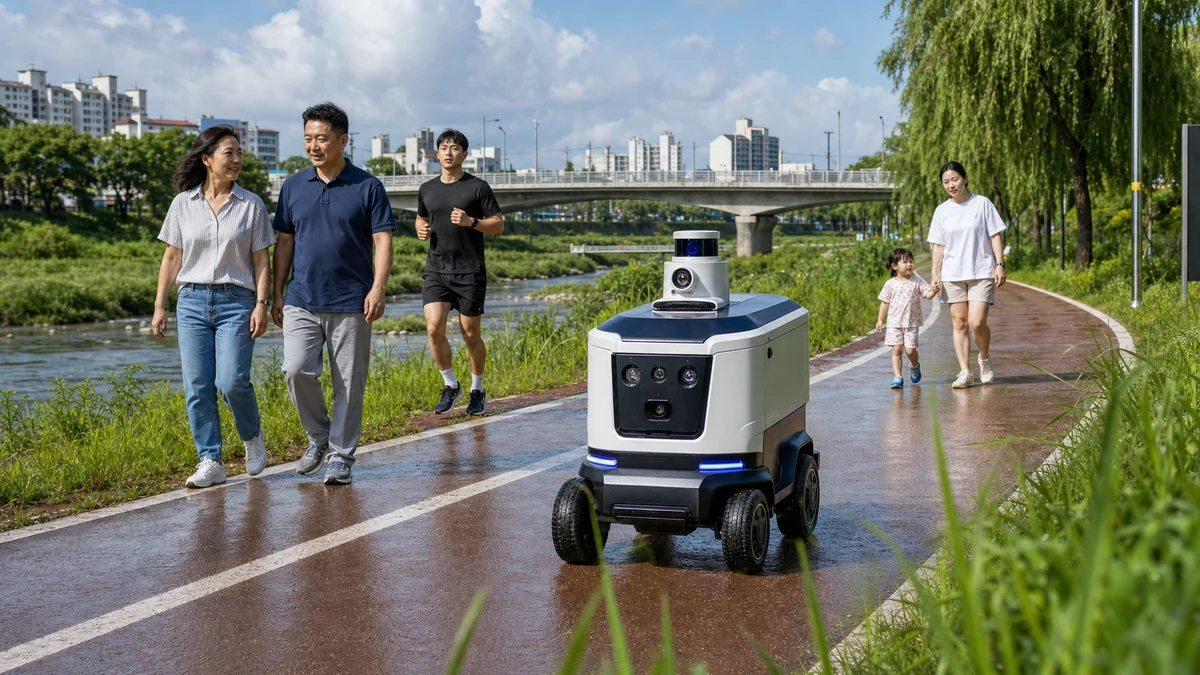
A new kind of police presence along the river
In Jeonju, a South Korean city best known for its traditional hanok village, bibimbap and a carefully preserved image of old Korea, a more futuristic sight is beginning to blend into everyday life: an autonomous patrol robot rolling along a riverside walking path used by local residents for exercise, commuting and evening strolls.
Officials in North Jeolla province — formally known as Jeonbuk State in English-language usage tied to South Korea’s recent administrative rebranding — say they plan to expand operations of the robot, called Nubion, in the second half of this year after several months of real-world use on a popular urban streamside trail in Jeonju. The machine has been patrolling daily since December along an approximately 5-mile round-trip section of the Jeonjucheon stream walkway, between Hongsan Bridge and Hyocheon Bridge in the city’s Wansan district.
That may sound modest by the standards of splashy tech unveilings, but the significance lies less in the robot itself than in where it is operating and how often. This is not a demonstration inside a convention hall, a tightly controlled industrial site or a fenced-off pilot zone. It is moving through a public pedestrian space where ordinary people walk dogs, jog after work, push strollers and linger by the water.
For American readers, think less of a police cruiser on a city street and more of a security robot quietly circulating on a busy greenway, park path or riverfront promenade — except in this case, the local government appears to be trying to integrate that presence into the daily rhythm of urban life rather than treating it as a temporary novelty.
According to provincial officials, the goal now is to build on that routine operation by selecting additional suitable sections near Jeonjucheon and the nearby Samcheon stream by September, then deploying two more patrol robots later this year. If budget conditions allow, officials say another one or two could be added next year.
Why this matters in South Korea’s local-government system
To understand why this development is drawing attention in Korea, it helps to understand who is running it. The expansion is being overseen by the Jeonbuk Autonomous Police Commission, a provincial-level body focused on community safety issues close to residents’ daily lives. South Korea’s “autonomous police” system can sound confusing to Americans because it does not mean a fully independent local police department in the U.S. sense. Rather, it refers to a form of decentralized policing administration intended to give regional governments a greater role in shaping public-safety policy on local issues.
In practical terms, that means the commission is not just showcasing a piece of hardware. It is testing whether autonomous tools can become part of neighborhood-level policing and public-safety management in spaces that residents use every day. That distinction matters. Around the world, local governments often announce robotics pilots with great fanfare, only for those machines to disappear after a brief trial. What makes Jeonju’s case notable is the emphasis on repeated, daily use and on gradual expansion based on on-the-ground experience.
The project also reflects a broader South Korean pattern: local governments frequently serve as laboratories for visible technology experiments, especially when those projects can be tied to public services. South Korea has long invested heavily in digital infrastructure, smart-city systems and public-sector technology. But some of the country’s most interesting experiments are not happening only in Seoul, the capital and tech hub. They are also taking place in regional cities, where officials are trying to apply advanced systems to ordinary urban spaces without fundamentally remaking them.
Jeonju is an especially interesting setting for that effort. The city is often marketed to domestic and international visitors as a center of heritage and food culture. It is not usually the first place outsiders think of when imagining robotics and autonomous systems. That contrast — a city associated with tradition adopting a visible patrol robot on a public streamside path — helps explain why this story resonates beyond the immediate policy details.
From one route to a broader network
Officials say Nubion was first introduced after the project was selected through a National Police Agency public contest program, and the robot began service in December. Since then, it has accumulated operating experience on the Jeonjucheon route, a fact that appears to be central to the latest expansion plan.
Instead of scattering a large number of robots across the city from the outset, authorities appear to be following a phased approach: start with one route, observe how the system performs under real conditions, then decide where it can realistically operate next. By September, the commission plans to identify appropriate sections near Jeonjucheon and Samcheon, another stream corridor that forms part of the city’s everyday recreational geography.
That may sound like a bureaucratic detail, but the choice of route is arguably more important than the number of robots added. Autonomous systems do not perform equally well in all environments. A riverside pedestrian path has its own variables: cyclists passing at speed, children changing direction abruptly, uneven light conditions, weather shifts, pets, seasonal crowds and occasional maintenance obstacles. A route that works smoothly on paper may prove far less practical in repeated daily operations.
In other words, “suitable section” is not just planning jargon. It is the difference between a robot that becomes a reliable public-safety tool and one that becomes an expensive curiosity. The current Jeonjucheon route offers a real-world benchmark. Future sections will likely be judged, at least informally, by whether they can support the same kind of routine patrol pattern that officials have already established there.
For American readers, this is similar to how cities think about deploying new transit technologies, surveillance tools or even bike-share stations: the map matters as much as the machine. Where people actually move, gather and behave unpredictably often determines whether a project succeeds.
Technology meeting everyday urban culture
One of the most striking parts of the Jeonju case is that the robot’s presence is changing not only public-safety practice but also the visual culture of the city. When a machine patrols the same path every day, it stops being an event and starts becoming part of the scenery. Residents may begin to treat it less like a demonstration and more like a familiar fixture, the way people in American cities eventually stop noticing a traffic camera, bike dock or electric shuttle circulating along a defined route.
That shift from spectacle to routine is where this story becomes larger than one city or one robot. Much of the public conversation around artificial intelligence and automation tends to focus on dramatic questions: Will robots replace workers? Will self-driving vehicles transform transportation overnight? Will smart cities become fully automated? But in real civic life, technological change often arrives in smaller, more repetitive ways. A machine appears in a park. A kiosk becomes standard at a train station. A delivery robot begins using sidewalks on a university campus. After enough repetition, the once-strange becomes ordinary.
Jeonju’s streamside patrol experiment fits that pattern. The robot is not remaking the city’s infrastructure from scratch. It is being inserted into a space residents already know well. That makes the project less about engineering theater and more about social adaptation. How often do people encounter the machine? Do they change their walking patterns around it? Do they view it as reassuring, intrusive, amusing or ignorable? Those questions may ultimately matter as much as any technical performance metric.
South Korea offers fertile ground for this kind of experiment because it is both highly urbanized and generally receptive to visible technology in public settings. At the same time, acceptance is never automatic. Koreans, like Americans, can be skeptical when governments frame new devices as solutions before proving they work. That is one reason officials’ emphasis on continued operations and measured expansion is important. They seem to understand that legitimacy will come from consistency, not just promotion.
And the setting matters culturally. Streamside walking paths in Korean cities are not merely recreational amenities. They often function as accessible public spaces woven into neighborhood life — places for exercise, conversation, decompression after work and low-cost leisure. Introducing a patrol robot into that environment means inserting technology directly into the intimate texture of daily urban routine.
The promise — and limits — of a 90% accuracy goal
Officials have said their aim is to improve Nubion’s accuracy to more than 90% through continued machine learning and simulation training. That target sounds impressive, but it also raises a question that often gets overlooked in public discussions of autonomous technology: Accurate at what, exactly?
The information released so far does not specify the robot’s current accuracy level or the exact function the 90% benchmark is meant to measure. It could refer to navigation reliability, object recognition, patrol performance under defined conditions or another technical indicator. Without more detail, it would be premature to interpret the figure as a sweeping measure of the robot’s overall effectiveness.
Still, the statement tells us something important about the project’s direction. Officials are not presenting expansion as purely a matter of buying more units. They are pairing growth with an explicit performance-improvement goal. That suggests an awareness that public use in open pedestrian environments demands more than hardware deployment. It requires continuous refinement, especially if the machines are meant to operate safely and predictably around residents.
For American audiences accustomed to skeptical debates over facial recognition, predictive policing and automated enforcement tools, that distinction is crucial. A patrol robot on a public trail may sound less controversial than a citywide camera network, but it still invites questions about reliability, oversight and mission creep. What happens when the machine encounters unusual behavior? How does it distinguish between a benign anomaly and a genuine problem? What human supervision backs it up? What data does it collect, and how long is that data stored?
The available summary does not answer those questions, and responsible reporting means not filling in gaps with assumption. But it is fair to say that the next phase of this project will be judged not just by whether the robots can traverse more miles, but by whether they can do so in a way that local residents find useful, unobtrusive and trustworthy.
In that sense, the 90% target is less the end of the story than the beginning of a more serious one. Once a government project moves beyond pilot status and begins scaling, citizens and policymakers alike tend to demand clearer definitions of success.
A cautious expansion, not a sci-fi leap
There is a tendency, especially outside Asia, to describe South Korean technology stories in breathless terms, as if every new deployment signals the arrival of a hyper-automated future. The Jeonju patrol-robot plan is more grounded than that. It is incremental, budget-conscious and still conditional in important ways.
This year’s plan is relatively concrete: identify appropriate sections by September and add two robots in the second half of the year. Next year’s possible addition of one or two more units is explicitly dependent on budget conditions. That matters. It means officials are not claiming a fully funded, citywide robotics network is imminent. They are acknowledging a common reality in local governance, whether in South Korea or the United States: promising technologies still have to compete for limited public money.
That staged approach may actually improve the project’s odds. Large-scale technology rollouts often fail when officials try to move too fast, treating expansion as proof of progress. By contrast, a system that grows step by step can be adjusted based on route performance, public response and maintenance needs. If one section of a stream path proves unsuitable, the city can change course without having overcommitted.
The method also underscores that Jeonju’s experiment is, at heart, a public-space management project. The robot may symbolize cutting-edge technology, but the operational questions are practical and familiar: Which routes are workable? How often can the machines patrol them? Are residents comfortable sharing space with them? Can the city sustain the program financially?
For U.S. readers, a useful comparison might be a midsize American city testing autonomous shuttles downtown or deploying security robots in a waterfront district, then deciding expansion one corridor at a time. The story is not that the future has arrived in full. It is that local government is trying to make a narrow slice of the future usable on a real sidewalk.
What Jeonju’s experiment says about the future of public safety
The broader significance of Jeonju’s plan lies in how it frames public safety in the age of automation. Much of the robotics conversation globally has centered on factories, warehouses, military applications and private-sector delivery systems. Patrol robots in a neighborhood stream corridor suggest another possibility: autonomous machines as a modest layer of civic presence in public life.
That does not mean robots are replacing police officers, nor does the available information support making that claim. Instead, the project appears to reflect an effort to supplement routine monitoring in public spaces with an autonomous platform that can repeatedly cover the same route. If that sounds less dramatic than the popular imagination of humanoid policing, that is because real-world adoption usually is.
Yet even modest uses can have broader consequences. Once citizens grow accustomed to robots moving through parks, trails and pedestrian zones, the public conversation can shift from “Should this exist at all?” to “Under what rules should it operate?” That is often the turning point for emerging technology. Acceptance of presence comes first; debate over governance follows.
In Jeonju, the immediate focus remains practical: daily patrols along a roughly 5-mile streamside route, selection of additional operating sections by September, two more robots later this year and an effort to push performance beyond a 90% accuracy goal through ongoing training. But beneath those administrative details is a larger picture of how technology enters civic life — not as a one-time spectacle, but through repeated contact in ordinary places.
For a city known internationally more for old tiled roofs and culinary tourism than for robotics, that quiet transition is especially telling. It shows how South Korea’s technological ambitions are no longer confined to flashy urban megaprojects or Seoul-centric narratives. They are increasingly visible in regional cities, in neighborhood spaces and in the mundane routines that define daily life.
Whether Jeonju’s patrol robots become a durable model for other Korean cities will depend on results that have yet to be seen: route selection, operational stability, public reception, budget support and transparent measures of effectiveness. But even at this stage, the city offers a revealing snapshot of what the next phase of urban automation may look like. Not a dramatic takeover, not a science-fiction transformation — just a robot on the path, showing up again tomorrow, and the day after that, until it becomes part of the walk.
Comments
Post a Comment