South Korea moves to cut egg prices with imports and retail discounts as consumers feel food inflation
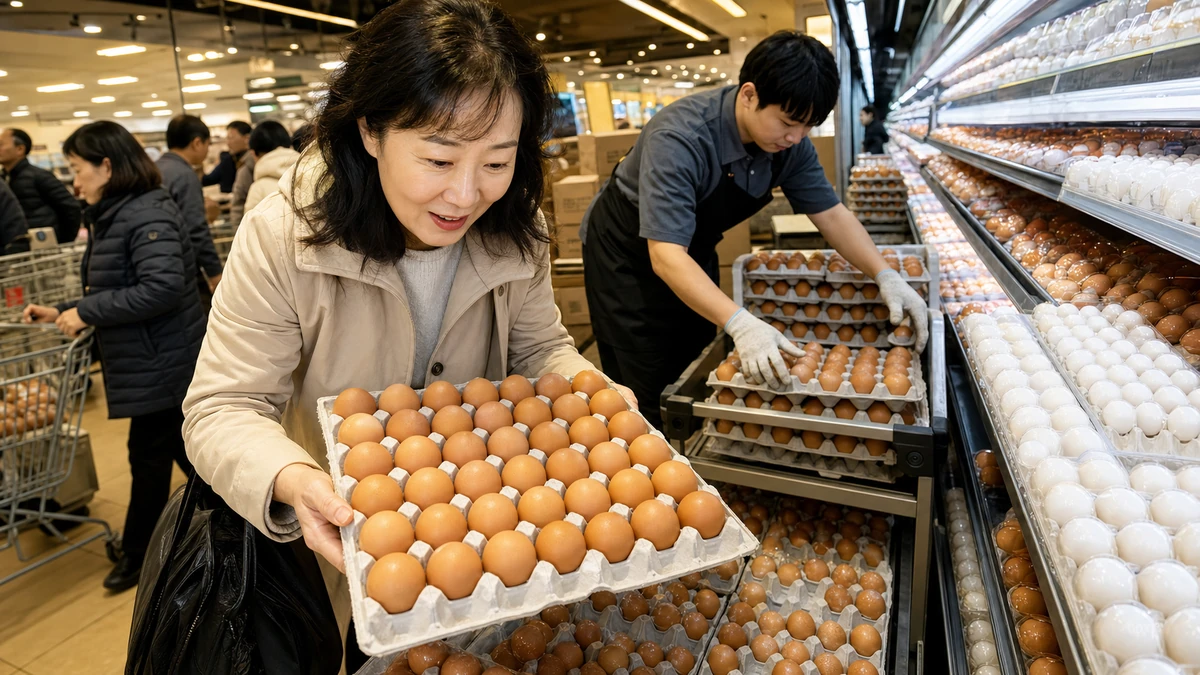
South Korea turns to imported eggs to ease a familiar kitchen-table pressure
South Korea is taking an unusually direct step to bring down the price of one of the most basic items in the refrigerator: eggs. Beginning July 16, imported fresh eggs sold in packs of 30 at E-Mart stores nationwide will drop to 4,980 won, or about $3.60, down from 5,890 won, according to the country’s Ministry of Agriculture, Food and Rural Affairs.
For American readers, the policy may sound a little like a government trying to cool grocery bills by coordinating imports and working with the nation’s biggest supermarket chains to make sure lower wholesale costs actually show up on store shelves. That is essentially what South Korea says it is doing. The move is not being presented as a one-off sale or a temporary promotion by a retailer. Instead, officials are framing it as part of a broader cost-of-living response, one aimed at a product that matters both to home cooks and to businesses that rely on eggs as a core ingredient.
In South Korea, where food prices are closely watched and inflation in everyday necessities can quickly become a political issue, eggs carry outsized symbolic and practical weight. They are a breakfast staple, a common lunchbox ingredient and a key input for bakeries, snack makers and prepared-food companies. When egg prices rise, the impact spreads beyond the supermarket aisle and into bakery counters, convenience-store shelves and restaurant supply chains.
The government said it discussed the measure at the third meeting of its summer task force on stabilizing the supply of agricultural and livestock products, held at the government complex in Sejong, the administrative city south of Seoul where many ministries are based. That setting matters in the Korean context: policy on food prices is often handled with a high level of bureaucratic coordination, especially during periods of seasonal volatility. Summer, with its heat, transportation concerns and pressure on fresh-food supply chains, is one of those periods.
The price cut itself is notable because it pushes a 30-egg carton below 5,000 won, a psychological threshold that officials appear to believe consumers will notice. In the same way American shoppers often pay attention to whether gasoline falls below a round-number price point or whether a grocery staple dips under a certain dollar figure, Korean consumers can be highly sensitive to visible, everyday benchmarks. The government’s announcement was explicit not only about the size of the price reduction but also about when it would begin and where shoppers could find it, suggesting that credibility depends on being able to see the change in the store, not just hear about it in a policy briefing.
Why eggs matter so much in South Korea’s inflation debate
Eggs occupy a special place in household economics because they are both ordinary and unavoidable. They are inexpensive compared with meat or fruit, but they are bought regularly, used in many dishes and noticed when prices move sharply. That makes them a kind of inflation bellwether. In the United States, policymakers and consumers often use eggs as shorthand for broader grocery stress; South Korea is no different.
But there is also a distinctly Korean angle. Korean home cooking depends heavily on versatile ingredients that can stretch a meal without stretching a budget, and eggs fit that role well. They show up in side dishes, rice bowls, soups and school lunches. In a country where many consumers shop frequently for fresh food rather than buying large quantities in bulk, even relatively small increases in price can feel immediate and recurring.
The impact extends well beyond the home. Korean bakeries, dessert chains and packaged-food makers use eggs in large volumes. So do the neighborhood shops and franchise cafes that help define the country’s dense urban food economy. When officials talk about stabilizing egg supply, they are not only addressing the family grocery basket but also the cost structure facing businesses that make pastries, breads, sandwiches and other prepared foods.
That helps explain why the latest government plan targets more than one part of the market at once. Retail consumers are one audience, but industry buyers are another. The strategy suggests that Seoul is trying to blunt downstream price increases before they hit finished products, not just lower the sticker price on raw eggs for shoppers. In practical terms, that means an egg imported through a government-backed supply effort could affect the price of a carton in a supermarket and also the ingredient bill of a bakery that supplies neighborhood storefronts.
For Americans used to a more arm’s-length relationship between government and grocery pricing, South Korea’s approach can seem interventionist. But in many Asian economies, including South Korea, governments often take a more visible role in managing essential food supply during periods of instability. The policy goal is less about permanent price control and more about sending a market signal: more supply is coming, it is being distributed through major channels and consumers should begin to feel relief soon.
A supply plan measured in the hundreds of millions
At the center of the policy is scale. The South Korean government said it is pursuing an additional 200 million imported fresh eggs. About 10 million eggs are being supplied this week to E-Mart, Lotte Mart and the Korea Bakery Association, with plans to follow that initial allocation with roughly 20 million eggs a week.
Those numbers matter because they show the government is trying to avoid the appearance of a token release. In food markets, a headline figure alone can be misleading if products do not arrive steadily enough to shape expectations. Officials appear to understand that. By laying out not just the total import target but also the weekly flow, they are signaling that this is intended as an ongoing pipeline rather than a single shock to the market.
That predictability is important for retailers and food businesses alike. A supermarket chain can advertise a lower price more confidently if it believes supply will keep coming. A bakery group can make purchasing plans if it expects access to eggs not just this week but over the next several weeks. In other words, supply stability is not only about quantity; it is also about cadence.
The inclusion of the Korea Bakery Association in the initial distribution is especially revealing. It shows the government is trying to support institutional and commercial users, not just household shoppers. In the American context, it would be somewhat like making sure lower-cost eggs reach both grocery chains and a major trade group representing bakers, so that the benefits ripple through both retail and food manufacturing.
There is also a logistics story here. South Korea’s food system is highly centralized in some respects, with large retailers playing an important role in how quickly policy can be translated into shelf prices. E-Mart and Lotte Mart are among the country’s best-known big-box retailers, similar in broad terms to national chains that many Americans would recognize as mass-market grocery and household shopping destinations. By routing imported eggs through those distribution networks, the government is using existing consumer touch points rather than creating a separate emergency channel.
That approach may sound technocratic, but it speaks to a broader reality of inflation politics. Consumers do not feel a policy when containers arrive at a port. They feel it when an advertised price at a familiar store goes down. South Korea’s officials, in effect, are trying to connect those dots publicly: import volume, weekly distribution, retail availability and a specific consumer price.
From policy paper to checkout lane
The most immediate consumer-facing piece of the announcement is the new price itself: 4,980 won for 30 imported fresh eggs at E-Mart starting July 16. That is a reduction of 910 won from the previous 5,890 won price. On paper, the change is modest in dollar terms, but in grocery politics modest changes in staple goods can carry disproportionate meaning.
The government’s emphasis on a common 30-egg pack is also telling. In South Korea, as in the United States, packaging format can determine whether a policy lands with consumers. A lower price on a hard-to-find specialty size would do little to change behavior. A lower price on a standard carton format sold through a national chain is much more likely to register.
There is a communication strategy embedded in that decision. By naming the retailer, the date and the exact pack size, the government gives consumers a way to verify the announcement for themselves. That matters because food-price policies are often judged not by intentions but by whether shoppers believe they are real. If a family walks into a store on July 16 and sees a carton priced below 5,000 won, the government can credibly claim the policy reached the checkout lane.
It also helps that the change comes at a time when South Korea, like many countries, has seen households become more price-sensitive about daily necessities. Grocery inflation tends to be felt most acutely not in luxury foods but in staples that are bought repeatedly. Eggs, like rice, cooking oil or milk, are part of the mental running total consumers carry from one shopping trip to the next.
American readers may recall how egg prices in the United States became a talking point during inflation spikes and bird flu disruptions. Even when the absolute cost increase per purchase did not break a household budget, the symbolism was powerful because eggs are such a basic item. South Korea is now navigating a similar dynamic, with policymakers apparently eager to show they can act before high prices become entrenched in public frustration.
The plan’s success, of course, will depend on whether the lower sticker price is maintained and whether supply remains sufficient as demand responds. If consumers flock to the cheaper cartons and shelves empty quickly, the political benefit could fade. That is one reason the weekly supply schedule may be just as important as the headline discount.
Discounts across agriculture and livestock products add another layer
The imported egg measure is only one piece of a broader government effort to keep summer food costs in check. Separately, the agriculture ministry said participating retailers have been offering discounts on all agricultural and livestock items from July 2 through Sept. 2. In other words, South Korea is pairing a supply-side intervention in eggs with a wider consumer discount campaign covering additional food products.
Those are two different tools. The egg plan focuses on bringing in more product and channeling it through major retailers and industry groups. The broader summer discount program focuses on lowering the burden at the point of purchase. Together, they form a classic two-track response to cost-of-living pressure: increase supply where shortages or high prices are acute, and subsidize or support discounts where households need more immediate relief.
That layered approach reflects how governments often respond when inflation is politically sensitive but not easily solved by a single measure. A discount program can offer quick visible relief, but if supply is tight, discounts alone may not be sustainable. More imports can help, but they may take time to affect shopping behavior unless paired with retail execution. Seoul appears to be trying to do both at once.
The timing matters as well. The nationwide agricultural and livestock discount program began earlier, on July 2, while the lower imported egg price is scheduled to start on July 16. That overlap creates a sustained summer window during which consumers may feel several different policy efforts at once. For officials, that likely helps reinforce the idea that the government is not waiting for markets to self-correct on their own.
In South Korea, the phrase often used in these discussions is “livelihood prices,” referring to the cost of the everyday goods people actually buy, not abstract inflation measures. It is a concept American audiences can relate to even if the wording is different. Politicians in the United States routinely talk about kitchen-table issues for much the same reason: the public often judges economic stewardship by what happens at the grocery store, the gas pump and the pharmacy counter.
By focusing on visible food costs during the summer, South Korean officials are clearly aiming at that same lived experience. Eggs are part of the message, but so is the idea that the government is watching household budgets broadly.
The balancing act: Consumer relief vs. protecting domestic farmers
Any plan built on imports raises an obvious question: What happens to local producers? South Korean officials have tried to address that concern directly. Lee Jae-wook, a supply official at the Korea Agro-Fisheries and Food Trade Corp., or aT, said the government would continue to look for new import countries to build a stable egg supply system and ease the burden on consumers. At the same time, he said imported fresh eggs would be pursued in a balanced way, taking into account domestic poultry farms and overall egg supply conditions.
That is an important political signal. Governments can lower prices in the short run by opening the import valve, but doing so too aggressively can anger domestic farmers, who may already be facing high feed costs, weather risks and volatile demand. South Korea’s poultry sector is not just an economic constituency; it is also part of a broader policy interest in maintaining food security and rural stability.
So the government is walking a familiar line. It wants to show consumers that it can act decisively when staple prices rise, but it also wants to reassure domestic producers that imports are a stabilizing tool, not a permanent replacement. That balancing act is common in agricultural policy around the world. The United States has its own versions in debates over imported produce, dairy supports and emergency market interventions.
The mention of finding new import countries also underscores the fragility of food supply chains in an era shaped by disease outbreaks, weather disruptions and geopolitical uncertainty. Diversifying supply sources can make a market less vulnerable to sudden shocks. But it can also introduce new regulatory, sanitary and diplomatic considerations, especially for a product as sensitive and perishable as fresh eggs.
Notably, the government did not identify those potential new source countries or give a detailed timetable for expanding them. That leaves some unanswered questions about how durable the current strategy may be. Still, the statement reveals the direction of travel: South Korea is not treating this as a purely short-term retail event. It is also thinking about how to build a more resilient import structure for a product that can become politically charged very quickly.
Whether that can be done without creating friction with domestic producers will depend on market conditions in the coming weeks. If imports help bridge a temporary gap and prices moderate without undercutting local farms too severely, the policy may be seen as a practical success. If tensions emerge between consumer relief and farm economics, the debate could sharpen.
What this says about South Korea’s economic playbook
At one level, this is a straightforward grocery story: cheaper eggs are coming to store shelves. At another, it offers a window into how South Korea manages everyday inflation. Rather than relying on a single lever, officials are linking imports, retail distribution, industry allocation and discount programs into a coordinated supply-chain response.
That is what makes the egg announcement more than a narrow retail development. It shows a government trying to demonstrate execution. The ministry did not simply say more eggs would be imported. It tied the policy to a total target of 200 million eggs, an initial release of roughly 10 million this week, a future pace of about 20 million a week and a concrete price at a specific national retailer starting on a specific date.
Those details matter because they create a testable promise. In the weeks ahead, the real question will be whether the announced flow of eggs moves as planned through the distribution system and whether consumers continue to see the benefits in stores. For food manufacturers and bakery operators, the key issue will be whether improved access to eggs actually eases procurement pressure.
For international observers and food businesses watching South Korea, the episode is also a case study in a government using modern retail infrastructure to carry out price-stabilization policy. It is not simply importing food and hoping the market handles the rest. It is actively shaping the route from border entry to supermarket shelf and to industry buyers.
That kind of coordination may become more common as governments confront persistent volatility in food prices. Climate shocks, supply bottlenecks and global market swings have made staples more politically sensitive than they were a decade ago. In that environment, competence is judged not only by whether officials announce relief but by whether that relief is visible, measurable and fast.
South Korea is betting that consumers will notice a cheaper carton of eggs and take it as evidence that the government is responding to pressure on household budgets. Whether that perception lasts will depend on what happens after July 16, when policy meets the shopping cart. But the message from Seoul is already clear: when the cost of a basic ingredient becomes a public concern, the state is willing to intervene across the supply chain to try to bring it down.
Comments
Post a Comment