Families in South Korea’s Jeju Air disaster press for answers as criminal case stalls 17 months later
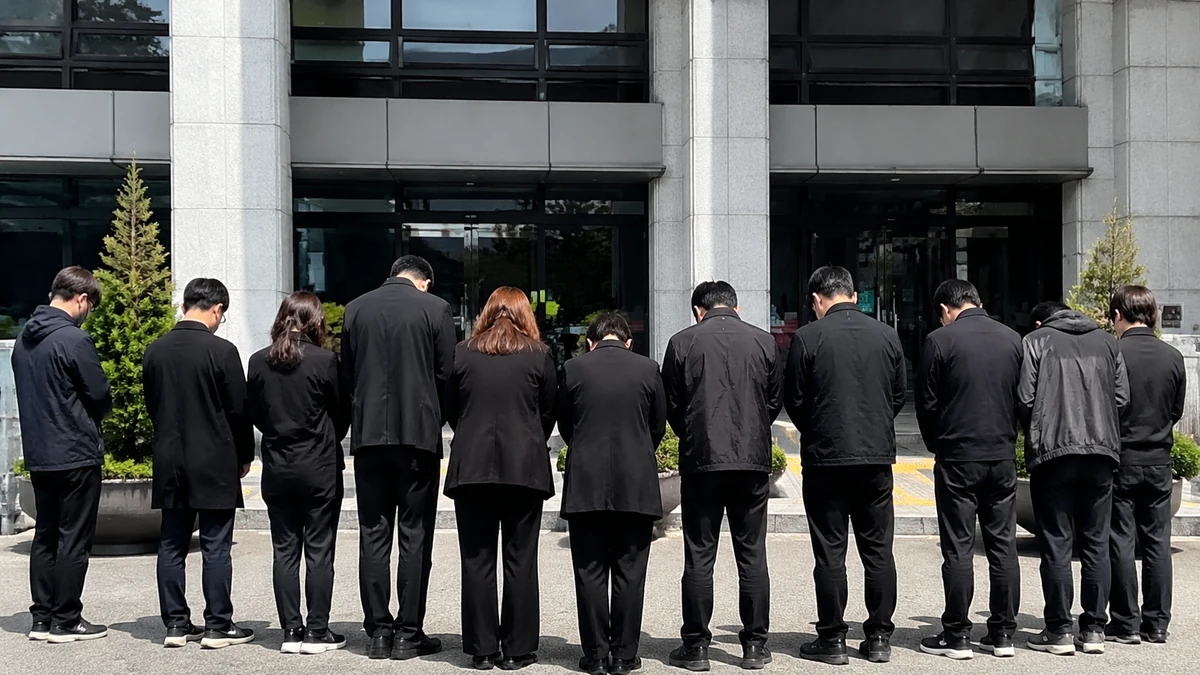
Families say time has deepened the wound
More than a year after a Jeju Air passenger plane disaster at South Korea’s Muan International Airport, relatives of the victims are again forcing an uncomfortable public question into the spotlight: How can a mass-casualty aviation case remain so legally unresolved for so long?
According to the account summarized by South Korean media, a family association representing victims said June 3 that 17 months after the disaster, not a single person has been arrested or indicted. The group is urging a special police investigation unit to carry out supplemental investigation and calling on prosecutors to make decisions more quickly on possible criminal responsibility.
That may sound procedural, but for families of the dead, procedure is often where grief hardens into civic anger. In major disasters, the first stage is rescue, recovery and mourning. The second stage is the one that determines whether a society believes it has truly learned anything: a clear public accounting of what went wrong, who made which decisions, whether safety rules were followed and whether anyone in authority will be held legally responsible.
In the United States, readers have seen versions of this pattern after aviation crashes, industrial accidents and mass tragedies where investigations stretch on for years. Families do not simply want sympathy. They want a credible answer from institutions. They want to know whether delays reflect necessary caution or bureaucratic drift. They want to know whether “ongoing investigation” is a sign of rigor or a cover for paralysis.
That is the emotional and political force of the families’ statement in South Korea. Their complaint is not just that they are still waiting. It is that, after 17 months, they feel the system has not reached the stage where responsibility is being meaningfully assigned at all.
Why “zero arrests, zero indictments” matters
The phrase the families used, that there have been “zero arrests and zero indictments,” carries a punch that goes beyond raw numbers. In any legal system, an arrest or indictment is not the same thing as guilt. South Korea, like the United States, requires legal process and proof. But when relatives invoke that number publicly, they are not making a technical point about criminal procedure. They are expressing a lived sense that the case has not moved from tragedy into accountability.
That distinction matters. A long investigation can be justified in a complicated aviation case, especially if multiple institutions, technical findings and layers of oversight must be reviewed. But the public does not experience time the way investigators do. For victims’ families, each passing month without visible legal action can feel less like diligence and more like institutional retreat.
The family association’s statement appears to be aimed at that exact gap between official process and public perception. Their message, as summarized in Korean coverage, is not simply that they dislike the pace of the investigation. It is that an investigation that never seems to arrive at decisions about responsibility stops looking like justice in motion and starts looking like accountability deferred.
That tension is familiar in many democracies. After a major disaster, authorities often ask the public for patience, arguing that technical complexity demands careful review. Families, meanwhile, ask a different question: At what point does patience become permission for institutions to outlast outrage?
By emphasizing the absence of arrests or indictments 17 months after the crash, the families are reframing the debate. They are not focusing only on what investigators have done. They are focusing on what the investigation has failed, in their view, to reach: a point where responsibility is defined in a way the public can understand.
A South Korean tragedy with a broader lesson about public trust
For American readers, some Korean institutional details may be unfamiliar, but the underlying stakes are not. In South Korea, as in the United States, major disasters often become tests not only of emergency response but of governmental legitimacy. The question is no longer just whether authorities responded in the moment. It is whether the state can later explain itself clearly enough to preserve public trust.
The families said they had expected faster progress after the investigation was transferred from the South Jeolla provincial police agency to a special investigation unit under the National Office of Investigation. That expectation is easy to understand. When a case is elevated to a special unit, the move signals seriousness, expertise and urgency. To grieving families, such a transfer naturally suggests that the case is entering a more decisive phase.
Instead, according to the families’ statement, that promise has not been fulfilled. Their disappointment appears to be rooted less in the institutional reshuffling itself than in what followed: no visible legal breakthrough and no outcome that has convinced them the process is nearing resolution.
This is where the story becomes larger than one crash. South Korea has spent years wrestling with how the country investigates and remembers mass tragedies. In the Korean public sphere, catastrophe is rarely treated as a closed chapter once the immediate crisis ends. A disaster continues to live in public memory through inquiries, official reports, prosecutorial decisions, legislative debate and the families’ own campaigns for truth.
That feature of Korean civic life can be hard to understand if one sees a tragedy only as a single event on a calendar. In South Korea, as in many countries with strong protest cultures and vivid collective memory, the aftermath can become as politically defining as the disaster itself. The public asks not only what happened, but whether the institutions charged with finding the truth are worthy of trust.
That is why this renewed statement from the families matters. It is not simply a memorial appeal. It is a direct challenge to the credibility of the accountability process.
What the families are asking for now
The demands made by the family association are notable for their dual nature. They are calling for supplemental investigation by the special police unit, which suggests they believe important facts still need to be more fully established. At the same time, they are asking prosecutors for a swift disposition, meaning a faster decision on whether to bring charges or otherwise formally conclude the criminal review.
Those two demands might seem contradictory at first glance: investigate more, but also move faster. In reality, they reflect a common frustration seen in disaster cases around the world. Families are saying, in effect, that if there are still unanswered questions, then investigators must pursue them thoroughly. But if authorities have already had ample time, then they should not be allowed to hide behind endless procedure.
It is a sophisticated critique, and one that goes beyond emotion. The families are not merely venting grief. They are articulating a theory of public accountability: that a legitimate investigation must be both complete and comprehensible, and that legal caution cannot become a permanent substitute for public explanation.
In practical terms, they appear to be demanding two things from the state. First, if there are gaps in the factual record, close them. Second, if the factual record is strong enough to support prosecutorial judgment, make that judgment. What they reject is the limbo in between, where institutions continue to operate but produce no outcome visible enough to satisfy the public interest.
That point resonates far beyond South Korea. In the United States, families affected by airline crashes, bridge collapses, school shootings and industrial failures often describe the most agonizing phase as the long stretch after headlines fade but before accountability arrives. Public attention moves on. Institutions slow down. Families are left to become archivists, advocates and pressure groups all at once.
The Korean families’ statement fits squarely into that global pattern. It is a demand not only for justice, but for movement.
Why the passage of 17 months has become a story in itself
The length of time since the crash is central to why this issue has re-entered the news cycle. Seventeen months is not just a chronological marker. It has become a moral one. In the families’ view, the clock itself is evidence that the official response has failed to produce a convincing endpoint.
Governments and prosecutors often resist that framing, and sometimes for legitimate reasons. Aviation disasters can involve technical reconstruction, document review, expert consultation and overlapping lines of responsibility among airlines, airports, regulators and contractors. Criminal accountability, in particular, can be far harder to establish than moral blame. A public may feel that someone obviously failed; a prosecutor still must prove a specific legal offense against a specific person.
But those realities do not erase the political meaning of delay. In democracies, elapsed time changes the burden on the state. At the beginning, authorities ask for space to investigate. As months pass, they take on a greater obligation to explain what has been done, what remains unresolved and why decisions are still pending.
That burden appears to be at the center of the families’ dissatisfaction. Their message is not simply that they disagree with investigators. It is that they no longer find the pace or trajectory of the process persuasive.
There is also a deeper issue at work: when a disaster remains unresolved in the public mind, it does not stay in the past. It becomes an ongoing civic problem. The crash is no longer remembered only as a deadly event. It is remembered as a test of institutions that is still underway.
That dynamic is especially important in societies where public memory of tragedy is bound up with demands for reform. A crash investigation is not only about assigning blame after the fact. It is also about demonstrating that safety systems, oversight structures and legal mechanisms are capable of self-correction. If authorities cannot show that clearly, then every delay becomes part of the scandal.
The cultural context: grief in Korea often becomes public advocacy
American readers may be more used to seeing victims’ relatives appear at press conferences, testify before Congress or push for lawsuits and legislative change. South Korea has its own version of that civic tradition, though it often plays out with a particular intensity. Bereaved family groups in Korea frequently emerge as organized moral voices in the public square, not simply private mourners.
That does not mean grief is politicized in a cynical sense. It means grief is often transformed into structured public action. Families form associations, issue statements, demand meetings with officials and press for institutional reform. In Korean society, where hierarchy and official process can be powerful, such groups can serve as crucial counterweights, insisting that personal loss not be absorbed into bureaucratic language.
The family association in this case is doing exactly that. By releasing a public statement and criticizing the lack of arrests or indictments, the group is refusing to let the case settle into administrative abstraction. It is insisting that the tragedy remain visible not just as sorrow, but as a question of state responsibility.
There is another cultural point worth noting. In many Korean disaster cases, the pursuit of truth is not viewed as separate from mourning. For some families, establishing how and why the deaths occurred is part of the mourning process itself. Without that knowledge, grief remains suspended. Without a clear finding on responsibility, remembrance can feel incomplete.
That may help explain the sharp tone captured in the summary, including the families’ assertion that “ultimately no one has taken responsibility.” Legally, that is not the same as saying no one ever will. But socially and emotionally, it is a devastating judgment. It says the process so far has not produced an answer the bereaved can live with.
In that sense, this is not only a law-and-order story. It is also a story about how democratic societies metabolize trauma and whether public institutions can meet citizens where grief and accountability intersect.
What comes next for South Korea’s institutions
The significance of the families’ appeal lies partly in what it asks of multiple institutions at once. The criticism is not confined to investigators. It extends to prosecutors and, by implication, to the broader system that should connect fact-finding to legal judgment. The families are asking South Korea’s accountability machinery to function as a chain rather than a series of disconnected offices.
That is a crucial point in any disaster response. Emergency recovery may be the work of one set of agencies, but public trust ultimately depends on coordination among many: police, forensic teams, regulators, prosecutors and political leaders. If one part of that system moves while another stalls, the public experiences the whole process as failure.
The summary also notes that forensic teams had reportedly returned as recently as April to search again for unrecovered remains at Muan International Airport. That detail is symbolically powerful. It underscores that the disaster is not yet finished in either physical or institutional terms. Recovery, memory and legal responsibility remain entangled.
For South Korean authorities, the challenge now is not only to continue their work but to communicate its purpose and timeline with far greater clarity. If there are reasons charges have not been filed, those reasons will matter. If supplemental investigative steps are needed, those steps will matter. What may matter most, however, is whether the public is given a credible explanation that does not sound like delay for delay’s sake.
For readers outside Korea, this may be the most universal part of the story. A nation’s response to a major aviation disaster is measured not only by the immediate emergency but by the quality of the reckoning that follows. Families are often the first to see when that reckoning has stalled. When they speak publicly after 17 months and say no one has been arrested or indicted, they are doing more than venting frustration. They are warning that time itself is eroding confidence.
In that sense, the families’ statement is not a backward-looking act of remembrance. It is a present-tense demand for institutional proof. South Korea’s investigators and prosecutors do not owe the public predetermined results. They do owe a process that is active, legible and capable of reaching conclusions. Until that happens, this disaster will remain not just a tragedy of the past, but a test of public accountability in the present.
Comments
Post a Comment