Lee Jung-hoo’s 10-game hitting streak offers another sign that Korea’s next big baseball star is settling into the majors
A timely swing in a small window
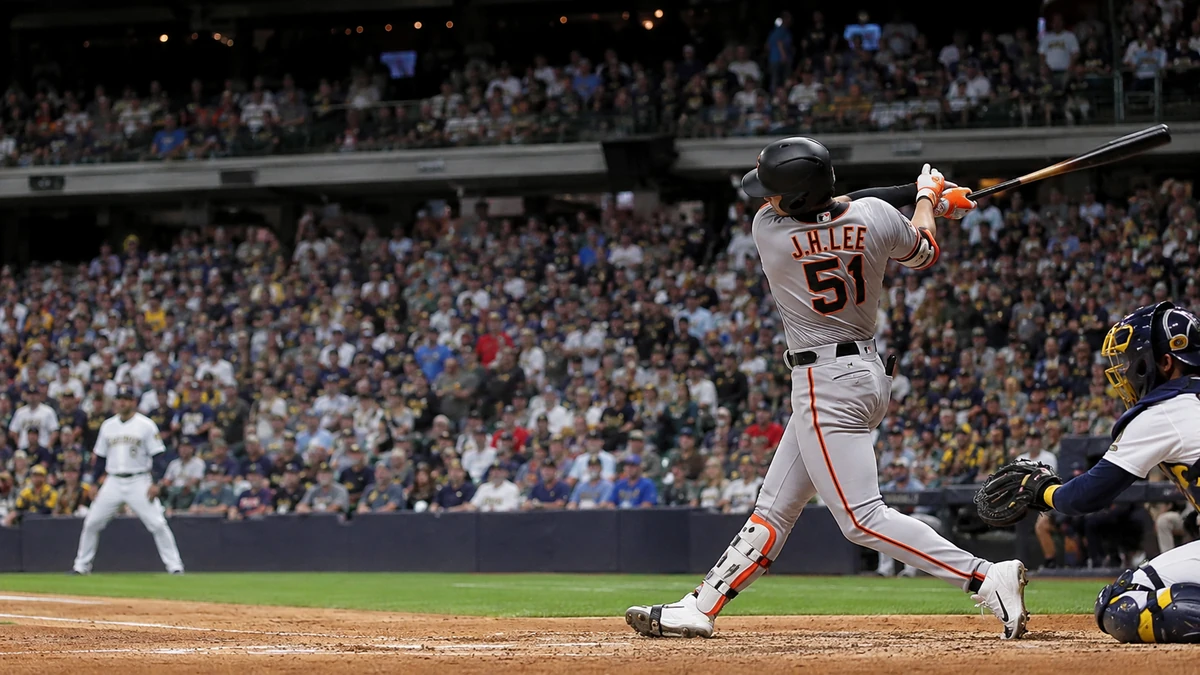
For a hitter, there are nights when a single plate appearance says more than an entire box score. That was the case for San Francisco Giants outfielder Lee Jung-hoo, who came off the bench against the Milwaukee Brewers and delivered a pinch-hit RBI single that extended his hitting streak to 10 games, according to Yonhap News Agency.
On paper, the line was compact: one at-bat, one hit, one RBI. But the context matters. Lee entered in the top of the eighth inning at American Family Field in Milwaukee with San Francisco trailing 4-2. He was not starting, not guaranteed multiple looks at pitching, and not working with the rhythms that everyday players often rely on. He got one chance, in a game state where the margin for error had narrowed, and he produced immediately.
That is why this was more than a routine statistical update. Pinch-hitting is one of baseball’s hardest jobs, and American fans know the type of pressure that comes with it. A player is asked to sit for much of the night, stay mentally locked in, then face a fresh arm in a high-leverage moment with little room to ease into the game. Veteran bench specialists have made careers out of that role, but even established stars often say it is among the toughest assignments in the sport.
For Lee, the result carried extra weight because it fit into a much larger pattern. His single pushed his season batting average to .307, with 61 hits in 199 at-bats, and it kept alive a 10-game hitting streak that has become one of the clearest signs that his offensive rhythm is not only back, but strengthening. For a player who represents more than just his own club performance in the eyes of many fans in South Korea, it was the kind of moment that resonates on both sides of the Pacific.
In American sports terms, this is the kind of development that turns a player from an interesting international arrival into a nightly storyline. It is not just that Lee got a hit. It is that he is beginning to produce in the kinds of moments that make fans, coaches and opposing teams think of him as a constant problem rather than a novelty.
Why 10 straight games matters in baseball
Hitting streaks can be overhyped in baseball, especially in a sport that now leans heavily on advanced metrics. But they still tell a useful story, particularly when attached to a hitter whose game is built around contact, bat control and consistency. Getting a hit once is ordinary. Doing it for 10 consecutive games means solving a different puzzle each night: a different pitcher, a different game plan, a different score, a different defensive alignment, and often a different emotional environment.
That is why Lee’s streak stands out. Ten straight games with a hit is not just a hot afternoon stretched over a calendar week. It suggests that a hitter’s timing is sound, his approach is steady, and his adjustments are holding up over repeated tests. In an era of elite velocity, sweeping breaking balls and nonstop scouting data, maintaining that level of steadiness is not accidental.
According to the Korean report, this marks Lee’s first double-digit hitting streak of the current season. It also brings him within one game of the 11-game personal best he set in 2024, while reinforcing a broader pattern: he has shown before that when he finds his timing, he can sustain it. The summary also notes that he previously had a 10-game hitting streak in 2025, evidence that this is not some isolated spike but a recurring trait in his offensive profile.
American baseball audiences are used to judging players through sustained trends rather than one-night highlights. A solo home run might make a highlight reel, but a long run of productive at-bats often tells executives and evaluators more. In Lee’s case, the streak suggests a hitter whose floor may be rising. The batting average of .307 is itself a recognizable benchmark for any U.S. audience. In baseball shorthand, crossing the .300 line still carries cultural meaning, even in a modern game transformed by analytics. It remains a quick, intuitive signal that a player is doing something difficult over a meaningful sample.
And Lee is not sitting at .307 after a handful of early-season games. He has reached that mark over nearly 200 at-bats, enough volume to make the number more persuasive. That does not guarantee where he will finish, of course, but it does make the performance harder to dismiss as a fluke. Opponents have scouting reports. Pitchers know his tendencies. Defenses can shade accordingly. He is still finding ways to stack hits.
The significance of a post-injury surge
Part of what makes this stretch so notable is when it is happening. Lee recently returned from a stint on the injured list because of back tightness, according to the Korean summary. For any hitter, back trouble is especially delicate. The baseball swing depends on rotation, balance, torque and timing, all of which can be disrupted by even minor discomfort in the lower back or core. A player may technically be healthy enough to return, yet still need days or weeks to recover full explosiveness and feel at the plate.
That is why Lee’s post-injury production deserves attention. Many players come back first and hit later. Lee appears to be doing both at once. Instead of looking tentative or rusty, he has shown immediate sharpness. The pinch-hit RBI single in Milwaukee was just the latest example of a player not merely surviving his return to action, but helping change games again.
There is also a psychological side to this that baseball people understand well. Injury recovery is not only about pain management or medical clearance. Hitters often talk about regaining trust in their body, especially in something as repeated and violent as the rotational act of swinging a bat. Timing can lag. Confidence can lag. Decisions can lag. A hitter may be physically available before he is fully himself. Lee’s recent performance suggests those pieces are reconnecting quickly.
The Korean summary makes an important distinction here: this is not just about getting back into the lineup. It is about producing regardless of role. Whether starting or entering as a pinch-hitter, Lee has been able to preserve the quality of his at-bats. That matters because it points to a more durable form of offensive readiness. Some players need the routine of a start to find their footing. Lee, at least on this night, showed he could step into a high-stress spot cold and still deliver.
For the Giants, that is the kind of form that can deepen lineup flexibility. For Korean fans following him from afar, it is also reassurance. Lee is one of the most visible Korean position players in Major League Baseball, and every indication that he is back in rhythm is read not just as a team update, but as a signal about how Korean talent is holding up on the sport’s biggest stage.
Why Lee matters beyond San Francisco
To understand why a single in Milwaukee becomes international news, it helps to understand Lee’s place in Korean baseball culture. South Korea has sent several notable pitchers to the majors over the years, and more recently a few prominent hitters, but everyday position players who arrive with star-level expectations still attract special attention. Lee was already a major figure before crossing to MLB, known in South Korea as one of the country’s premier contact hitters and as a face of the sport.
That matters because Korean sports fandom, much like American sports fandom, often extends far beyond local rooting interest when a homegrown star moves abroad. Think of the way American basketball fans follow a U.S. player in Europe or soccer fans track an American in the English Premier League. In South Korea, a player like Lee becomes both an individual competitor and a kind of ambassador, whether he seeks that role or not.
There is a broader cultural frame as well. Americans are now familiar with the phrase “Korean Wave,” or hallyu, through K-pop, Korean dramas, films and food. But sports is part of that global visibility too, even if it gets discussed differently. A Korean star succeeding in MLB is not the same thing as a chart-topping music act or an Oscar-winning movie, but it taps into the same broader reality: South Korean talent increasingly travels well on world stages that were once treated as largely Western or U.S.-dominated.
Baseball has a particularly interesting place in that exchange. Unlike some parts of Korean popular culture that still require explanation for U.S. audiences, baseball is a shared language. An RBI single, a batting average above .300, a 10-game hitting streak — those numbers translate instantly. They do not need subtitles. That is one reason moments like Lee’s performance in Milwaukee draw attention internationally. They are legible in the simplest possible way.
The Korean report argues that the visibility of Korean players abroad contributes to the international standing of Korean sports more broadly. That is not an exaggeration. Fans and executives do draw conclusions, fairly or not, from a single player’s success. When a Korean hitter adapts to major league pitching and does so consistently, observers naturally ask what that says about player development, training standards, competitive depth and the overall strength of baseball in South Korea.
Lee is not responsible for carrying those narratives alone. But he is clearly operating inside them. Every productive week becomes evidence in a larger conversation about how Korean baseball fits into the global game.
Translating Korean baseball excellence for an American audience
For American readers who do not follow Korean baseball closely, Lee’s rise is best understood not as a novelty story, but as part of a long-running pipeline of elite international talent making the major leagues more global. MLB clubhouses now regularly blend players from the United States, Latin America, Japan, South Korea and elsewhere. Yet the adjustment remains real. Moving from one baseball culture to another is not simply a matter of talent translating automatically.
The strike zone feels different. Pitch usage looks different. Media attention is different. Travel is different. Expectations are different. Even the daily rhythm can be disorienting. A star in one league arrives in the majors and must prove himself all over again, usually against deeper bullpens and more relentless scouting than he has ever faced.
That is one reason Lee’s .307 average is meaningful. It represents not just statistical production, but adaptation. Nearly 200 at-bats into the season, he is not surviving through surprise alone. Opponents know who he is. They have adjusted. He has adjusted back.
American fans may also notice that Lee’s appeal is a little different from the profile that dominates social media clips. He is not defined solely by tape-measure power or maximum exit velocity. His reputation is built more on feel, contact and repeatable at-bat quality, traits that often earn deep respect inside baseball even if they generate fewer viral moments. In that sense, his game resembles the kind of player traditionalists love and managers trust: someone who puts the ball in play, keeps innings alive and can deliver in a constrained opportunity.
That style also helps explain why a pinch-hit single can feel so revealing. In one swing, Lee showed the traits that made him valuable before he ever reached the majors: readiness, bat-to-ball skill and the ability to keep a game moving in his team’s direction. Even in defeat or limited action, players can deliver a message. On this night, Lee’s message was that his current run is credible.
There is also a subtle but important distinction between being a promising international player and being a dependable major league contributor. The first label can be sustained by reputation for a while. The second has to be earned repeatedly, in ordinary games, under modest pressure, over long stretches. Lee’s 10-game hitting streak is part of that second process. It is how players become fixtures rather than attractions.
What comes next for Lee and for the larger story
The immediate question is obvious. Can Lee extend the streak to 11 games and match the longest run of his professional career in the majors? The Korean summary frames that as the natural next checkpoint, and it is. Baseball can humble anyone overnight, and no streak is safe. But the reason this story continues to gather force is that Lee’s current form looks explainable rather than random.
He is healthy enough to contribute. He is producing after returning from injury. He is handling changing roles. He is maintaining a batting average above .300 over a meaningful sample. And he is compiling hits across 10 straight games, an indicator that his timing and decision-making are both in a good place.
That combination is why the performance against Milwaukee lands as something more than a one-night note. It sits at the intersection of individual resilience, team utility and international significance. For the Giants, Lee’s swing offers offensive stability and late-game usefulness. For South Korean fans, it reinforces the sense that one of their signature baseball talents is finding his footing again after a physical setback. For the broader baseball audience, it is another reminder that major league success is increasingly shaped by players whose careers and fan bases stretch far beyond the United States.
There is a tendency in global sports coverage to overstate what one game means. This is not that. One pinch-hit RBI single does not define a season. But it can sharpen the outline of a trend already underway. Lee’s latest hit did exactly that. It extended a streak, nudged his average upward, and underscored that his return from the injured list is becoming less a recovery story and more a performance story.
That distinction matters. Athletes are often first discussed through the lens of what happened to them: the injury, the transfer, the pressure, the adjustment. The next phase is when they are discussed for what they are doing now. Lee appears to be entering that phase again. His recent run is compelling not because it is sentimental, but because it is measurable.
For American readers still getting acquainted with him, that may be the simplest way to frame the moment. Lee Jung-hoo is not just a Korean star trying to hold his place in the majors. Right now, he looks like a hitter in form, a player whose results are forcing attention in the most baseball way possible: one clean line in the box score at a time.
Comments
Post a Comment