Hirokazu Kore-eda Returns to Seoul, Bringing a New Film and a Familiar Affection for Korean Audiences
A Japanese auteur returns to a city that no longer feels foreign
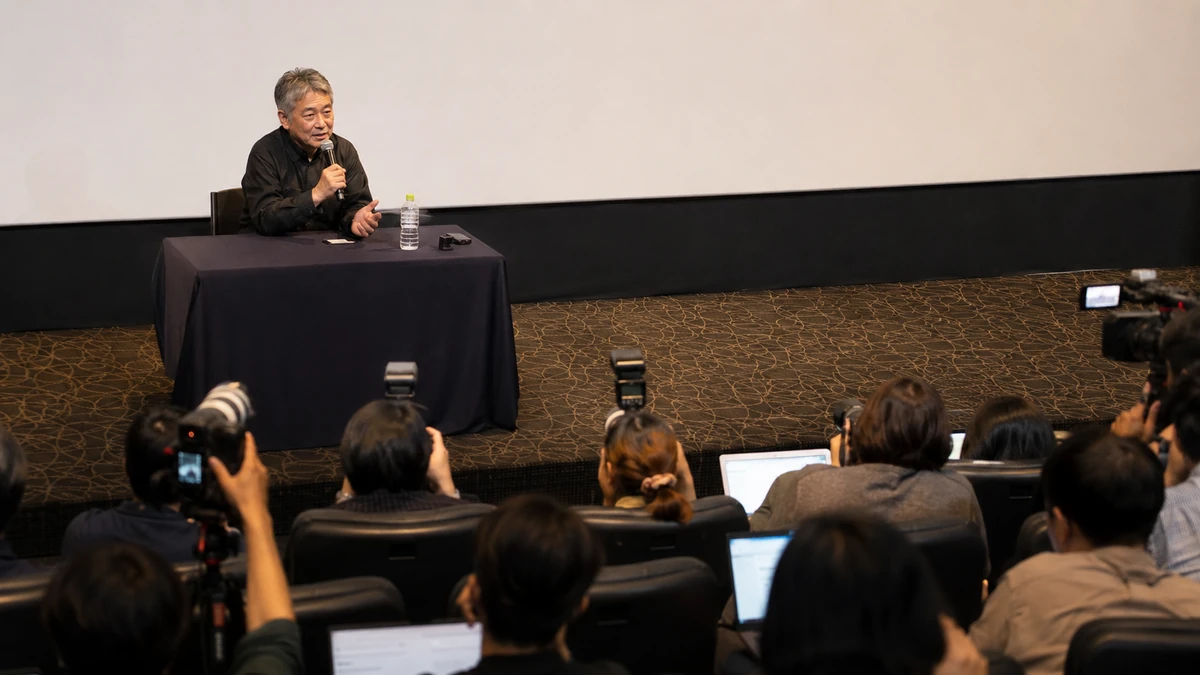
When Japanese filmmaker Hirokazu Kore-eda appeared in Seoul this week to introduce his new movie, the visit landed as more than a routine stop on an international publicity tour. At a press screening and news conference held Tuesday at Megabox COEX, a major multiplex in Seoul’s upscale Gangnam district, the director spoke openly about what he called a “special affection” for South Korea. For many American moviegoers, that may sound like standard festival-circuit diplomacy. In Seoul, it carried more weight.
Kore-eda is not just another famous foreign director passing through one of Asia’s biggest entertainment capitals. He is already a familiar figure to Korean audiences, in part because of his 2022 film “Broker,” which was made with Korean actors including Song Kang-ho, Gang Dong-won and the singer-actor IU. That film gave Song the Cannes Film Festival’s best actor award, a point of enormous pride in South Korea and a milestone that helped cement Kore-eda’s place in the Korean movie conversation. So when he returned to Seoul roughly a year after his previous visit, the reaction was less like a distant celebrity call and more like the return of a respected collaborator.
That distinction matters in South Korea, where movie culture remains unusually engaged, sophisticated and emotionally invested. Hollywood directors often treat overseas premieres as obligations. In Korea, filmmakers who show genuine familiarity with local actors, crews and audiences can be received almost as honorary insiders. Kore-eda’s comments this week reflected that dynamic. He said he had already made a film in Korea, knows many staff members and colleagues there, and despite not being able to visit often because he has been filming in Japan, still feels a deep fondness for the country.
For American readers, a useful comparison might be the kind of bond some European directors have built with New York arthouse audiences over decades, or the way certain international filmmakers become especially beloved at Telluride or Toronto. But in Korea, the connection can feel even more immediate. The country’s film audience is both highly local and highly global: deeply protective of Korean cinema, yet eager to embrace foreign artists who engage its creative community with seriousness rather than novelty.
That is part of why Kore-eda’s latest Seoul appearance became news in its own right. It was ostensibly about a new release. It also functioned as a quiet reaffirmation that his relationship with Korean cinema, and with the people who watch it, is ongoing.
A new film uses science fiction to ask an old question about grief
The new movie, introduced in Korean coverage under the title “The Sheep in the Box,” is set in the near future and centers on a premise that sounds, at first glance, like science fiction. A humanoid robot modeled after a dead boy named Kakeru enters the life of an architect couple who lost their son. That setup could easily tilt toward dystopian spectacle or high-concept futurism. Kore-eda, however, is not known for making movies primarily about technology. He is known for making movies about people who live with absence.
That distinction is critical to understanding why the film is attracting attention. The emotional core of the story appears to rest not on the mechanics of artificial intelligence, but on the moral and psychological unease that comes when technology touches a wound that has never really closed. What does it mean to live beside a machine that resembles someone you loved? Is such a presence comforting, cruel, healing or all three at once? Can grief be softened by imitation, or does imitation only sharpen the pain?
Those are hardly niche questions in 2025. American audiences, too, are living through an era in which AI is moving from abstraction to intimate daily experience. Much of the debate in the United States has focused on jobs, misinformation and surveillance. But popular culture has long been preoccupied with a more private fear: whether technology can reproduce the people we lose, and whether we would even want it to. From “A.I. Artificial Intelligence” to episodes of “Black Mirror,” Western audiences recognize that unsettling borderland where memory, longing and simulation collide.
Kore-eda’s treatment is likely to be more restrained than those examples. His films have rarely relied on plot twists or technological dread to produce meaning. Instead, he tends to build emotional force through small gestures, domestic routines and the unresolved tensions that linger around ordinary life. In that sense, the humanoid in “The Sheep in the Box” may be less a science-fiction device than a pressure point. It forces the surviving family to confront how grief reorganizes love, memory and the definition of what counts as human presence.
The result, if Kore-eda’s past work is any guide, is a film less interested in predicting the future than in exposing the emotional contradictions people already carry. The near-future setting may give the story its architecture. The real subject appears to be something older and more universal: how families try, and often fail, to live with what cannot be restored.
Why family stories resonate so strongly in Kore-eda’s work
For viewers in the United States who know Kore-eda mainly as an acclaimed Japanese director but have not followed his body of work closely, his reputation rests on a consistent artistic preoccupation: family, especially the unstable, improvised and emotionally messy forms family can take. Whether in “Shoplifters,” “Still Walking,” “Like Father, Like Son” or “Broker,” he has returned repeatedly to households held together not by sentimentality but by need, guilt, tenderness and compromise.
That may sound familiar to Americans accustomed to hearing the phrase “found family” in television and film criticism. But Kore-eda’s approach is typically less slogan-driven and more quietly observational. He is not simply celebrating unconventional families. He is asking what obligations people assume toward one another when the usual social scripts fail. Biological ties, legal ties and emotional ties do not always line up in his films, and that friction is where much of his drama lives.
In South Korea, where family remains a deeply important social unit and public expectations around kinship can be powerful, those questions land with particular force. Korean audiences are often highly responsive to stories about duty, generational strain, unspoken sacrifice and emotional reserve within households. These themes are hardly unique to Korea, of course, but they resonate in a society where family identity still shapes everything from caregiving expectations to economic choices to social respectability.
Kore-eda’s sensitivity to those tensions helps explain why his work has found such a warm following there. He is Japanese, but his films often move in a tonal register that Korean viewers recognize: intimate, melancholic, attentive to silence and deeply aware that love is frequently expressed indirectly. His characters do not always say what they feel. The camera often notices what they cannot articulate.
That sensibility also travels well internationally. American audiences have embraced Korean films and dramas in recent years partly because they offer heightened emotion without always resorting to the ironic detachment that dominates much of U.S. entertainment. Kore-eda operates in a related mode, though with a distinctly Japanese cinematic cadence. He trusts viewers to sit with ambiguity. He does not hurry to explain people to themselves.
So while “The Sheep in the Box” introduces an apparently unfamiliar element in the form of a humanoid double, the movie’s central concerns are entirely in line with the director’s career. He remains interested in the same aching question: when someone is gone, what remains inside the family they leave behind?
The cast suggests a careful balance of grief, warmth and unease
The actors attached to the film have also become part of the conversation. Haruka Ayase, one of Japan’s most recognizable screen stars, plays the character Otone. Her presence signals emotional accessibility and mainstream appeal. Opposite her is Daigo, a member of the popular Japanese comedy duo Chidori, who plays Kensuke. Casting a comedian in a serious domestic drama can sound risky to outsiders, but it often creates precisely the tonal flexibility a filmmaker like Kore-eda wants.
American audiences have seen similar casting logic before. Think of how filmmakers use performers known for humor to unlock vulnerability, everyday awkwardness or emotional defensiveness. Comedy, especially in domestic stories, can reveal how people survive pain through routine, banter and emotional misdirection. A household in mourning is not sad every minute. It still contains habits, irritations, practical concerns and moments of accidental absurdity. Kore-eda’s films have long understood that grief and ordinary life do not take turns; they coexist.
That makes the Ayase-Daigo pairing particularly intriguing. One brings polished dramatic presence; the other brings a face many viewers associate with comic timing and everyday relatability. Together, they may help the film avoid becoming oppressively solemn. If the story is about a family making room for a humanoid likeness of a dead child, the performances will need to create emotional credibility around a premise that could otherwise feel abstract or contrived.
The role of the humanoid, played by Rimu Kuwaki, may be the film’s most delicate assignment. Characters like this can fail in two opposite ways. If played too mechanically, they become thin symbols rather than emotionally disruptive presences. If played too humanly, the conceptual tension evaporates. The audience must remain aware that this being is not simply the lost child returned, while still feeling why the adults might begin to treat him as something more than an object.
Kore-eda’s decision to visit Seoul alongside Kuwaki also drew attention. In promotional terms, bringing the actor who embodies the story’s central enigma signals confidence in the role’s importance. In artistic terms, it suggests that the humanoid is not just a plot device but the axis around which the film’s emotional weather turns.
For Korean viewers, who are often highly attuned to ensemble chemistry and performance nuance, that balance is likely part of the anticipation. For American audiences less familiar with the Japanese cast, the larger point is this: the film appears designed not as cold speculative fiction, but as a performance-driven drama in which casting choices are essential to translating an unusual premise into recognizable human feeling.
Why Kore-eda’s Korean connection matters beyond one movie
It is impossible to separate Kore-eda’s reception in South Korea from “Broker.” That film was not merely another international co-production. It was a moment of unusually visible creative exchange between one of Japan’s most acclaimed directors and some of Korea’s most prominent performers. Song, already one of Korea’s most revered actors, won best actor at Cannes for the role, giving the collaboration a symbolic afterlife that extended well beyond box office numbers.
In a region where history between Japan and South Korea remains politically sensitive, cultural partnerships can carry added resonance. The two countries share deep artistic influence and robust commercial exchange, but relations are also shaped by unresolved historical grievances stemming from Japan’s colonial rule of Korea from 1910 to 1945. Those tensions can flare in politics, education, trade and public memory. None of that disappears because a filmmaker says he loves Korea. But creative collaboration can sometimes open a different kind of conversation: less about official reconciliation than about sustained human and artistic familiarity.
That helps explain why Kore-eda’s words in Seoul were not treated as throwaway politeness. When he says he feels special affection for Korea and has many colleagues there, the statement lands in a space where such connections are noticed. Korean audiences tend to be alert to whether foreign public figures are engaging with the country superficially or meaningfully. Kore-eda’s history gives his comments credibility.
There is another layer here, too. South Korea has emerged not only as a powerhouse exporter of pop culture, through K-pop, film and television, but also as an audience market that international artists increasingly want to impress. A generation ago, the dominant narrative was about Korean creators seeking validation abroad, especially in Hollywood and Europe. That has changed. Now foreign filmmakers, actors and studios often recognize Korea as a place where discerning audiences can shape regional buzz and global prestige.
Kore-eda reportedly noted that he was happy to visit Korea with Kuwaki in part because the movie opened there early. That detail suggests Korean moviegoers are not being treated as an afterthought in a standard international rollout. They are being treated as a priority audience, one expected to respond with care and seriousness. In the language of the entertainment business, that is market strategy. In the language of culture, it is a sign of trust.
For Americans watching the broader Asian cultural landscape, this is worth noticing. The Korean Wave is often reduced in the United States to charting K-pop groups, Netflix dramas or beauty products on TikTok. But part of Korea’s growing influence lies in something quieter: it has become a place where global artists come to be read closely.
“Please see what is not visible”
The line from Kore-eda’s Seoul appearance that seems likely to linger is his request that audiences “please see what is not visible.” It is the kind of phrase that could sound opaque in English if stripped of context. In practice, it serves almost as a key to both the new film and his larger aesthetic.
On the surface, “The Sheep in the Box” presents viewers with something highly visible: a humanoid built to resemble a dead child. But Kore-eda appears to be asking audiences to look beyond the science-fiction premise and attend instead to the less obvious emotional terrain beneath it. The real drama may lie in what the characters cannot state plainly. Is the robot a comfort or an intrusion? Are the adults honoring memory or refusing grief? Does the presence of a substitute expose love’s endurance, or its vulnerability to replacement?
This emphasis on the unseen also resonates strongly with the traditions of East Asian family melodrama, where silence, implication and restraint often carry as much narrative force as explicit confession. American storytelling, particularly in mainstream film, tends to favor articulation: characters explain their wounds, confront each other directly and arrive at emotionally legible conclusions. Kore-eda is more inclined to let meaning accumulate in pauses, glances and routines. What matters is often not what happens, but what remains unsaid after it happens.
That is one reason his films can feel so quietly devastating. They do not necessarily push viewers toward a single emotional release. Instead, they leave behind an afterimage, a sense that the most important thing in the room may be the thing no one can bear to name. In asking Korean audiences to watch for “what is not visible,” he was also describing the kind of spectatorship his films invite: patient, emotionally attentive and willing to read the spaces around the dialogue.
It is a request that likely resonates in Korea, where audiences accustomed to emotionally layered dramas often pride themselves on catching nuance. But it also speaks to broader global anxieties in the age of AI and digital mediation. More and more of modern life is shaped by simulations, avatars, reconstructions and algorithmic approximations. Kore-eda’s reminder is almost countercultural: do not confuse what is present on the surface with the deeper truth underneath.
What this moment says about Korea’s place in global film culture
There is a final reason this visit matters. In Korea, entertainment news does not always revolve around celebrity gossip or opening-weekend spectacle. Sometimes it centers on a director discussing grief, family and the emotional risks of new technology. That in itself says something about the cultural ecology of the country’s film scene.
South Korea is now one of the few places in the world where a broad public conversation can comfortably move between blockbuster economics and art-house sensibility. Audiences that support major commercial franchises also make room for serious international cinema. Film festivals, multiplexes, critics and online fan communities all contribute to a culture in which a director like Kore-eda can generate attention not simply because he is famous, but because viewers care about the kind of emotional and philosophical questions his work raises.
For American readers, that may be a useful corrective to the flattening effects of the phrase “Korean Wave.” Korea’s global cultural prominence is real, but it is not monolithic. It is not just idol groups, beauty trends and streaming hits. It is also a moviegoing public willing to engage a meditative film about bereavement and a humanoid child. It is an entertainment press that treats a director’s statement about invisible emotions as headline material. And it is a cultural marketplace where a Japanese auteur’s return can symbolize not just promotion, but relationship.
That relationship is what made Kore-eda’s Seoul stop noteworthy. He arrived with a new film to sell, certainly. But he also arrived as a filmmaker whose connection to Korea has been built through collaboration, memory and mutual recognition. In a global media environment obsessed with scale, virality and instant reaction, there is something striking about the durability of that bond.
If “The Sheep in the Box” succeeds, it may do so not because of its futuristic hook, but because it returns to the oldest cinematic material of all: the love people keep for the dead, and the stories they tell themselves in order to go on living. That is a subject with no national border. Yet in Seoul this week, it was also a reminder of how art travels across borders anyway, carried by trust, history and the audiences willing to see what is not immediately visible.
Comments
Post a Comment