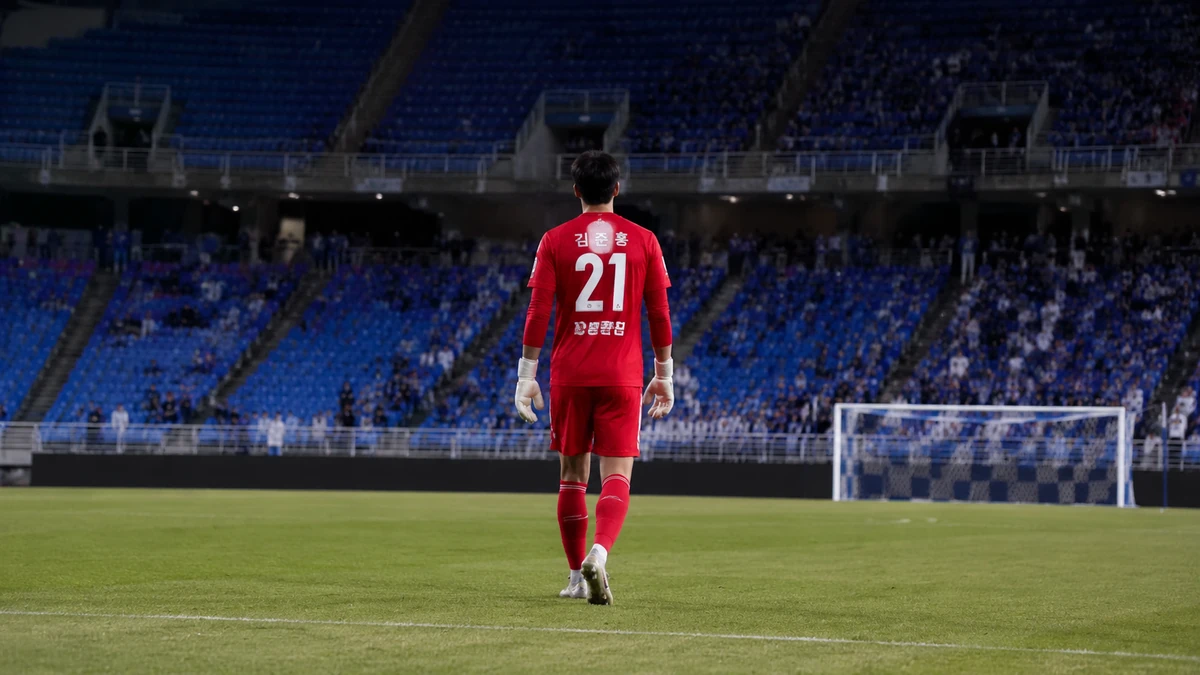
A goalkeeper signing that says more than it seems
In many soccer markets, a club announcing a permanent move for a goalkeeper in the middle of the season would register as sensible but hardly seismic. Strikers sell jerseys. Playmakers dominate highlight reels. Coaches and executives often talk about “statement signings” in the language of goals, speed and star power. But in South Korea’s fiercely competitive second division, where narrow margins can define an entire year, Suwon Samsung Bluewings’ decision to make 23-year-old goalkeeper Kim Jun-hong a permanent signing is the kind of move that can reshape a promotion race.
Suwon Samsung, one of the biggest and best-known names in Korean soccer, confirmed on June 4 that Kim’s loan spell would become a full transfer. Until now, Kim had been on loan while still tied to D.C. United of Major League Soccer. The move means he will remain with Suwon beyond this season, giving the club something every ambitious team craves: certainty at the most psychologically demanding position on the field.
That certainty is not based on reputation alone. It is grounded in production. Through 14 rounds of the K League 2 season, Kim had played 12 matches and conceded just 11 goals, a rate of 0.92 goals allowed per game. Among goalkeepers in the division with at least 10 appearances, he was the only one still under one goal conceded per match. He also led the league with six clean sheets, the soccer term for a full game without allowing a goal.
Those numbers matter anywhere, but they carry special weight in a league like K League 2, the second tier of South Korean professional soccer. For American readers, the easiest comparison is to a hard-fought minor-league promotion battle in which every point matters and every defensive lapse can change the financial and emotional trajectory of a storied club. Suwon is not just trying to have a respectable season. It is trying to reclaim its place closer to where its supporters believe it belongs.
That is what makes this more than a routine transfer update. Suwon did not simply keep a useful player. It chose to lock in the spine of a team it believes can survive pressure, manage ugly games and stay in the race for promotion over a long season. In soccer, and especially in promotion chases, stability in goal can be as valuable as a hot scorer. Sometimes it is even more valuable.
Why Suwon’s situation carries extra weight in Korean soccer
To understand why this transfer resonates, it helps to understand who Suwon Samsung is in the Korean game. The Bluewings are one of the traditional heavyweights of South Korean club soccer, backed historically by Samsung and carrying the expectations that come with a large fan base and a decorated past. For years, the club was associated with top-flight relevance, big matches and a standard that extended beyond simply staying competitive.
That is why life in K League 2 has felt, for many supporters, less like a rebuilding project and more like a detour that must be corrected. K League 2 is not a developmental side show. It is a serious, often bruising competition where teams chase limited promotion opportunities and where name recognition offers no guaranteed advantage. Clubs with stronger histories or bigger crowds still have to grind out results on smaller stages, in tight matches and under scrutiny that can feel disproportionate to the level.
For readers in the United States, the dynamic might resemble a proud franchise in another sport unexpectedly finding itself outside the elite tier and discovering that returning is harder than memory suggests. That sense of impatience shapes everything. A draw can feel like a setback. A defensive mistake can be interpreted as a symptom. A reliable performer, especially one in goal, quickly becomes central not just tactically but emotionally.
In South Korea, fans also tend to follow club identity and momentum closely. The Korean phrase often used around teams in a promotion fight is not just about talent but “stability” and “balance,” concepts that matter deeply in the week-to-week rhythm of the season. A goalkeeper who calms the back line and preserves points does more than make saves. He changes the atmosphere around the team. He gives defenders confidence to hold shape. He gives coaches room to be patient. He gives fans reason to believe that one-goal leads can actually hold.
That appears to be the role Kim has grown into in a remarkably short time. He arrived on loan ahead of the 2026 season, won the starting job immediately and has looked less like a temporary answer than a long-term foundation. Suwon’s permanent move simply formalizes what the season had already been suggesting: This player is no longer a stopgap. He is part of the club’s plan.
The numbers tell a clear story
Statistics in soccer can sometimes be misleading, particularly when they isolate one player from the collective structure around him. A goalkeeper’s numbers depend on the quality of the defenders in front of him, the tactical shape of the team and even game state. A club that dominates possession may shield its goalkeeper more often than one that absorbs pressure. But there are still numbers that cut through context, and Kim’s profile this season stands out.
Twelve matches and 11 goals conceded through 14 rounds is not just good; it is the sort of return that can anchor an entire campaign. A 0.92 goals-against average means Suwon is essentially asking opponents to produce nearly flawless efficiency to take points. In lower-scoring leagues and tight promotion races, keeping that figure under one can be enormously meaningful. A single goal often decides the result. Avoiding that one goal changes everything.
The six clean sheets might be even more revealing. Clean sheets are team statistics, but they usually reflect a shared discipline that starts with confidence in goal. A back line that trusts its goalkeeper defends differently. Fullbacks can recover with more conviction. Center backs can stay organized rather than panic. The entire team tends to make better decisions when it senses the last line of defense is secure.
Kim’s record also gains force in comparison with his peers. According to the figures highlighted in the Korean reporting, he is the only K League 2 goalkeeper with at least 10 appearances who has kept his goals-against average in the 0-point range, as Korean sports coverage often phrases sub-1.00 numbers. That comparison matters because it shifts the conversation from “solid addition” to “elite impact within this league.” He is not merely helping Suwon. He is setting a standard among regular starters across the division.
For American sports audiences accustomed to quarterback ratings, save percentages or earned run averages, there is a familiar logic here. It is not only the raw total that matters; it is the separation from the field. Kim is not just compiling acceptable numbers on a decent team. He is producing metrics that strongly suggest he has been one of the defining goalkeepers in the league so far.
And because he has been doing it from the opening stages of the season, those numbers also indicate trust earned over time. Coaches do not usually keep a goalkeeper in the starting role by sentiment. The position is too exposed. One costly error can swing a match, a standings table and, in extreme cases, a season narrative. The fact that Kim has remained the first choice tells its own story about how consistently he has performed.
From loan player to cornerstone
Loan deals are common across global soccer, and they come with obvious advantages. A club can plug a short-term need without committing years of wages or a major transfer fee. A player can find minutes elsewhere if he is blocked at his parent club. But loan arrangements also carry an inherent instability. If a player becomes essential too quickly, the borrowing club is left trying to win now while wondering whether the foundation beneath it will disappear later.
Suwon appears to have moved decisively to remove that uncertainty. In making Kim’s transfer permanent, the club is saying that his value is not confined to this spring or this summer. It sees him as part of the architecture, not just part of the furniture. That distinction matters in a long season and matters even more in a promotion battle, where consistency is often the difference between finishing in contention and fading into frustration.
Goalkeeper is a uniquely continuity-driven position. In many sports, coaches can rotate skill players, alter matchups or ride form. In soccer, clubs almost always prefer a settled No. 1. Communication patterns with defenders, timing on crosses, choices in distribution and the simple emotional trust built across weeks of training are hard to replicate when the role is unsettled. Locking down the starter is therefore not just a roster move. It is a way of locking down the team’s rhythm.
That seems especially relevant for Suwon. If the club believes defense and game control are the quickest path back toward the top end of Korean soccer, then it makes sense to secure the player at the center of that identity before uncertainty grows. Midseason decisiveness also sends a message to the locker room. Strong performances will be rewarded. The club is not waiting passively to see what happens. It is shaping its own future while the season is still unfolding.
There is also an important psychological dimension for the player himself. Loaned players often perform under a layer of ambiguity, balancing the demands of the current club with the unknowns of the next move. A permanent deal changes that. It gives the player clearer roots, stronger belonging and, ideally, greater freedom to focus purely on performance. For a young goalkeeper, that can be especially valuable. The position demands not only reflexes and technique but authority. Authority is easier to project when everyone knows you are not just passing through.
The D.C. United connection and what it says about player movement
Kim’s path from D.C. United to a leading role in South Korea’s second division adds an intriguing international layer to the story. For American readers, D.C. United remains one of MLS’s legacy brands, a club associated with the league’s early history even if its recent seasons have been more uneven. Seeing a player linked to that environment become an immediate answer for Suwon underscores a point that is increasingly true across global soccer: career trajectories are rarely linear, and a player’s best fit is often a matter of opportunity, timing and role rather than league prestige alone.
This is not a simple story of a player “dropping down” or “coming back.” It is a story about finding the right competitive context. Kim’s previous affiliation with an MLS club gives him an international résumé line, but what has mattered in Suwon is not where he came from. It is what he has done once he arrived. The most persuasive language in sports remains performance, and Suwon’s decision reflects that blunt truth.
The move also highlights how interconnected soccer development has become. Korean players can be tied to clubs abroad, return home on loan and quickly become central to a domestic promotion race. For clubs, that creates both risk and opportunity. They can access talent that has been shaped in different systems, but they also need to judge quickly whether adaptation will be smooth enough to justify a long-term commitment. Suwon appears to have made that judgment early and confidently.
For MLS observers, the story may also serve as a reminder that player evaluation is deeply situational. A goalkeeper who is one option in one environment can become indispensable in another. Styles differ. Team needs differ. Coaching trust differs. The transfer market often functions less as a ladder than as a network, with players moving to the place where their attributes solve the clearest problem.
In Suwon’s case, the problem was not difficult to identify. The club needed reliability, reduced goals conceded and a sense that matches would not unravel because of instability at the back. Kim has supplied those things, and the permanent deal suggests that everyone involved recognizes the fit.
Why defense can define a promotion race
There is a reason seasoned coaches often sound almost boring when discussing promotion campaigns. They talk less about flair than shape, less about spectacle than discipline, less about one brilliant night than about avoiding bad ones. In a league race stretched over months, entertainment value is secondary to repeatable outcomes. Teams that can protect narrow leads, survive flat attacking performances and keep accumulating points usually remain in the picture the longest.
That logic appears to be guiding Suwon’s thinking. The Korean summary of the move framed it as an indication of what the club considers its most important competitive edge. Not star scoring, but preventing goals. Not chasing highlight moments first, but preserving game stability. That is the kind of institutional choice promotion contenders often have to make.
For American readers, think of it as a baseball team deciding its identity will run through pitching and run prevention, or an NFL team recognizing that in cold-weather December football, defense and field position travel better than fireworks. In soccer, the equivalent is a goalkeeper and defensive structure that keep scores manageable, pressure low and point totals moving in the right direction even when the attack is not at its sharpest.
Suwon’s six clean sheets with Kim in goal are especially important in that respect. Clean sheets do not just produce victories; they protect against collapse. A team that knows it can keep opponents off the board enters close games with a different kind of confidence. It needs fewer goals to win. It can be more patient in possession. It can absorb stress without turning frantic. Over time, those small advantages accumulate into standings pressure on everyone else.
That is why the permanent transfer should be read as a competitive declaration. Suwon is not waiting until the offseason to decide which qualities it wants to build around. It has already identified one: a goalkeeper capable of giving the club a high floor every week. In a race where every point can prove decisive, raising the floor may be the smartest investment of all.
What supporters are really celebrating
Fans do not usually celebrate contract structures for their own sake. They celebrate what those contracts represent. In this case, Suwon supporters are likely reacting not simply to paperwork but to confirmation. The club has seen what they have seen: a team that looks more secure with Kim in goal and a season that feels more manageable because of it.
That emotional piece matters in Korea, where club support can be intense, communal and closely tied to weekly momentum. A goalkeeper who inspires calm can become a favorite quickly, even without the glamour afforded to forwards. Every saved shot, every punch through traffic, every composed claim late in a one-goal game becomes part of a larger story fans tell themselves about whether this season is finally moving in the right direction.
There is also something especially reassuring about defensive competence in a long campaign. Attack can fluctuate. Finishing streaks come and go. But if a fan base begins to believe the team will not give away matches cheaply, hope starts to feel less fragile. That may be the strongest subtext of this signing. Suwon has not merely retained a productive player. It has held onto one of the main reasons supporters can imagine the rest of the season with confidence rather than anxiety.
Of course, no single player guarantees promotion. Injuries happen. Form changes. Rivals adjust. And soccer, perhaps more than most sports, has a habit of punishing anyone who thinks the future is secure. But if clubs are judged by whether they recognize what is working and act before circumstances force their hand, then Suwon has made a clear and rational choice.
It has identified that one of the central pillars of its campaign is a 23-year-old goalkeeper who arrived on loan, won the job from opening day and proceeded to post the kind of numbers that stand out anywhere. By turning that loan into a permanent deal, Suwon has done more than tidy up its roster. It has announced how it intends to compete: with structure, with stability and with a belief that the road back begins by making the goal as hard to breach as possible.
In a sport where headlines usually belong to scorers, that may not look flashy. But for a club chasing promotion, it looks like sound judgment. And in Suwon’s case, sound judgment could be exactly what keeps the season on course.
Comments
Post a Comment