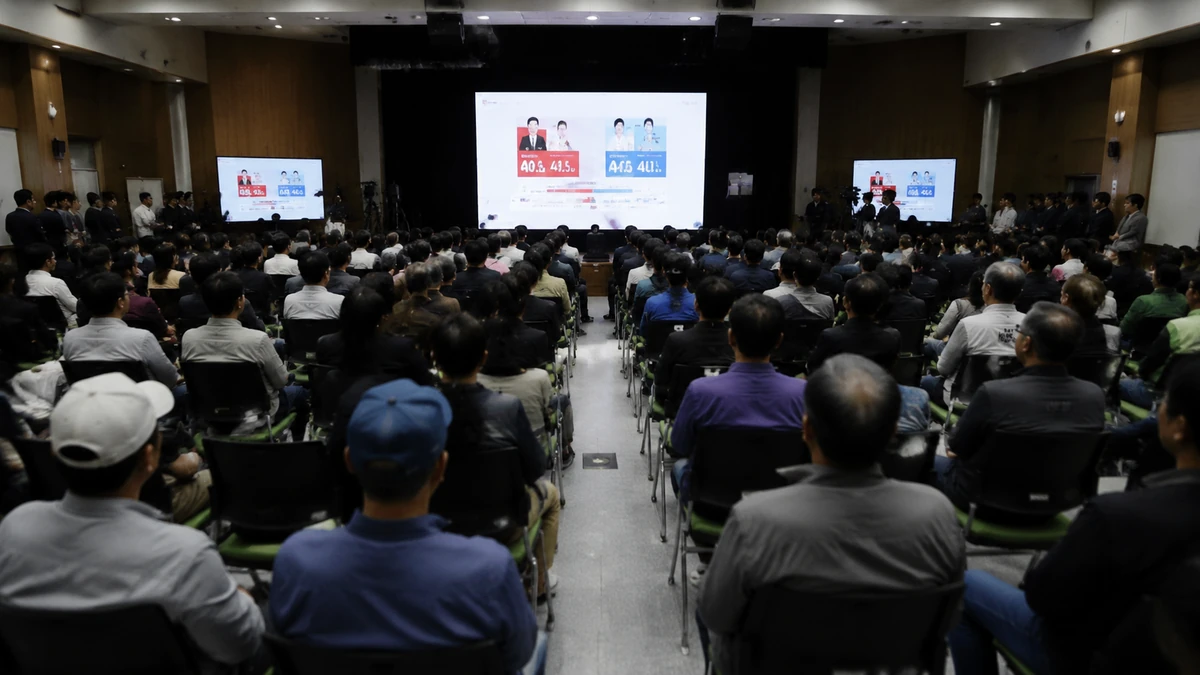
A former mining city votes for continuity
In the mountain city of Taebaek, once one of South Korea’s signature coal towns, voters have delivered a clear message about what kind of future they want. In local elections held June 3, voters reelected Mayor Lee Sang-ho, a conservative candidate from the People Power Party, giving him a second term and, with it, a renewed mandate to push an ambitious industrial makeover for a city that has spent decades living with the aftershocks of coal’s decline.
On paper, this was a municipal election in a relatively small city in Gangwon Province, far from Seoul’s political center and far from the global celebrity image many Americans associate with South Korea through K-pop, Korean dramas and cutting-edge tech. In practice, Taebaek’s vote carried a larger meaning. It was a referendum not only on one mayor’s record, but on whether residents of a long-struggling former mining community are willing to keep betting on a difficult transition toward clean energy, research infrastructure and critical minerals.
That makes Taebaek’s election results noteworthy well beyond South Korea. For readers in the United States, the city’s story may sound familiar. Think of Appalachian coal towns, parts of West Virginia or eastern Kentucky, or manufacturing cities across the Rust Belt that lost the industry around which local identity and livelihoods had been built. Taebaek is confronting a version of the same question: After the mines close and the jobs disappear, what comes next, and who gets to define it?
Lee’s victory suggests that many voters in Taebaek have chosen continuity over nostalgia. Rather than promise a return to the city’s industrial past, he has promoted a forward-looking, if still uncertain, economic strategy centered on new state-backed projects. The political significance of his reelection lies less in personality than in direction. Voters appear to have decided that rebuilding around new industries, however complicated, is more realistic than longing for a lost era.
In that sense, Taebaek’s election is not simply a local political result. It is a small but revealing case study in how communities shaped by fossil fuels are trying to reposition themselves in an era of energy transition, supply-chain competition and regional inequality. South Korea, like many advanced economies, is grappling with how to revive places left behind by structural change. Taebaek is now one of the clearest examples of how that struggle is playing out on the ground.
Why Taebaek matters in South Korea
To understand why this election resonates, it helps to understand what Taebaek represents in modern Korean history. Coal was once central to South Korea’s industrial rise, particularly during the country’s rapid development in the decades after the Korean War. Taebaek, located in a rugged mountainous area, was one of the places where that industrial story was lived most intensely. Its mines fed factories, homes and an economy racing toward modernization.
But the city also embodies the cost of economic transformation. In 1989, South Korea began what was known as the coal industry rationalization policy, a government-led restructuring that reduced the role of domestic coal as the country shifted toward other energy sources and a different economic model. The policy may sound technocratic, but its consequences were deeply human. Mines closed, jobs vanished, people moved away and local economies weakened. Taebaek became one of the country’s best-known former mining cities, carrying both the memory of national industrial success and the burden of post-industrial decline.
That historical backdrop matters because local elections in South Korea often function as more than administrative contests. Cities and counties elect their own mayors and county chiefs, and those positions can have significant influence over development priorities, state funding bids and the pace at which local plans are implemented. When an incumbent wins reelection, especially in a city facing long-term economic distress, the result is often read as a signal that voters want policy continuity rather than a reset.
That seems to be the case in Taebaek. Lee, who led the city during the previous term, campaigned on keeping major industrial transition projects moving. His argument, in effect, was that Taebaek cannot afford another cycle of drift. For a city that has already spent decades in demographic and economic decline, the appeal of continuity is easy to understand. Residents are not simply choosing a politician; they are choosing whether to keep following a development roadmap that has already been drawn, at least in broad outline.
There is also a distinctly Korean element here that can be unfamiliar to foreign readers: the phrase sometimes translated as “people’s choice” or “the public mood,” often used in election coverage, refers not just to partisan preference but to a collective sense of where a community believes its practical interests lie. In Taebaek, that practical concern appears to center on survival, jobs and relevance. The city’s voters were not casting ballots in an abstract ideological debate. They were weighing which strategy offers the best chance of keeping their city viable in the next decade.
The promise of a post-coal economy
Lee’s platform has focused on turning Taebaek into a base for new industries, especially clean energy and critical minerals. According to the Korean news summary, he has emphasized the uninterrupted implementation of major national projects worth roughly 1 trillion won, or hundreds of millions of dollars. The specific initiatives include an underground research facility, a clean methanol production plant and the creation of a critical minerals industrial complex.
Those project categories may sound technical, but together they amount to a proposed identity shift for the city. The underground research facility suggests an effort to repurpose the region’s geography and industrial legacy rather than simply erase it. In former mining regions around the world, policymakers often search for ways to turn old industrial landscapes into sites for research, energy, logistics or tourism. The logic is both practical and symbolic: If the old underground economy is gone, perhaps the underground itself can serve a new purpose.
The clean methanol project fits into a larger global conversation about alternative fuels and decarbonization. Methanol can be used in shipping, chemicals and energy applications, and “clean methanol” generally refers to production methods designed to lower emissions compared with conventional fossil-fuel pathways. For Taebaek, attaching itself to that kind of sector is a way of linking a local recovery story to broader energy trends that national governments and private investors increasingly take seriously.
The critical minerals industrial complex may be the most geopolitically significant piece of the plan. Critical minerals, a term now familiar to Washington policymakers and business executives, refer to materials essential for technologies such as batteries, electric vehicles, semiconductors and renewable energy systems. The United States, Europe, China, Japan and South Korea are all trying to secure supply chains in this space. For a place like Taebaek, that means the language of local development is no longer just about roads, markets and apartment construction. It is tied to the strategic industries of the 21st century.
That does not mean the transformation is guaranteed. Big industrial plans are often easier to announce than to complete, and former single-industry towns have heard redevelopment promises before. Still, from a political standpoint, the election shows that Taebaek’s residents appear willing to give this strategy more time. They have endorsed the idea that the city’s future lies not in preserving decline, but in trying to insert itself into new national and global economic networks.
For American readers, the closest parallel may be the growing number of U.S. communities seeking federal clean-energy investment through the Inflation Reduction Act, infrastructure spending or reshoring initiatives. Much like those towns, Taebaek is trying to make the case that yesterday’s industrial losers can become tomorrow’s strategic assets. Whether that happens depends on execution, financing and public trust. But the ambition itself tells us how deeply the terms of local politics have changed.
What voters were really choosing
In many democracies, local elections are shaped by personality, patronage and turnout patterns. Those factors matter in South Korea, too. But the meaning of Lee’s reelection in Taebaek appears to reach beyond incumbency advantage. The result can be read as an endorsement of continuity in governance and speed in implementation. In local politics, a second term often matters because it reduces the learning curve and gives an incumbent more time to move projects from announcement to construction and, ideally, to measurable economic effect.
That distinction is especially important in a city burdened by long-term stagnation. Voters in places like Taebaek are often less interested in rhetorical combat than in whether a leader can secure central government support, navigate bureaucracy and produce visible results. South Korea’s national politics can be fiercely polarized, but local voters frequently approach city hall with a more transactional set of questions: Will there be jobs? Will the population decline slow? Will public investment actually arrive? Will my children have a reason to stay?
By that standard, Taebaek’s election seems to have been less about restoring the past than redesigning the future. Lee’s campaign framed the issue not as a sentimental return to coal, but as a structural shift toward industries with a longer runway. That helps explain why the reelection matters. The public did not merely reward a sitting mayor. It appears to have granted political time for a transition agenda that is still far from complete.
This is also where Taebaek reflects a broader pattern in South Korean regional politics. Other local leaders in different parts of the country also won reelection in races where continuity and administrative competence were central themes. What sets Taebaek apart is the weight of industrial transition. Here, the stakes are unusually concentrated. A second term is not just about improving city services or managing routine development. It is about proving that a former coal city can write a second chapter.
That makes voter expectations sharper, not softer. Reelection offers stability, but it also narrows excuses. A mayor beginning a first term can argue that he needs time to assemble a team and establish priorities. A mayor entering a second term after running on major projects has less room to delay. The same continuity that can accelerate policy can also intensify public scrutiny. In Taebaek, the political honeymoon is likely over. What begins now is the test of delivery.
A local election with global echoes
What happened in Taebaek deserves attention because it speaks to a much wider dilemma: how resource-dependent communities navigate the end of one economic era without being abandoned in the next. That is a challenge visible not only in South Korea and the United States, but across Europe, Australia and parts of Latin America. As countries pursue cleaner energy systems and more resilient supply chains, the winners and losers of that transition are being sorted in real time.
Taebaek sits at the intersection of those forces. Its coal-era identity ties it to the old energy economy. Its redevelopment strategy ties it to the new one. And its election results show that local communities are not passive spectators in that shift. They are making political judgments about risk, opportunity and time horizons. They are deciding whether to accept the pain of transition in exchange for the possibility of renewal.
There is a temptation, especially in international coverage, to view South Korea mainly through the lens of Seoul: presidential scandals, North Korea tensions, Samsung earnings, blockbuster films and chart-topping pop groups. But places like Taebaek reveal another South Korea, one that looks more like the regional inequalities and post-industrial anxieties familiar to many Americans. The country’s dazzling global image coexists with deeply local struggles over depopulation, shrinking tax bases and the search for new economic purpose.
That coexistence is part of what makes Taebaek compelling. The same country known internationally for hypermodern urban life is also wrestling with the fate of communities built around industries that no longer drive national growth. In that respect, Taebaek is not a side story to South Korea’s success. It is part of the full picture, showing how uneven development can be even in highly advanced economies.
Its agenda also underscores how local politics is being pulled into larger geopolitical currents. Critical minerals are not merely an industrial buzzword; they are a strategic concern at the center of U.S.-China competition and global manufacturing policy. Clean energy projects are not simply green branding; they are bound up with climate goals, industrial subsidies and national security planning. That these themes are now central to a mayoral race in a former mining city says something about the scale of the changes underway.
For American readers, the takeaway is straightforward. Taebaek’s election is a reminder that the energy transition is not only about emissions targets or national legislation. It is also about whether towns built on old energy can build credible futures in the new economy. The politics of that transition may be local, but the implications are international.
The harder part starts now
If Taebaek’s voters have chosen a direction, the harder question is whether the city can turn that direction into durable results. Grand plans alone do not revive communities. They must survive permitting, funding negotiations, bureaucratic delays, market shifts and public skepticism. Residents who have lived through decades of decline are unlikely to be satisfied by slogans about innovation if those promises do not translate into jobs, business activity and a sense that the city is once again moving forward.
That is the pressure facing Lee as he begins his second term. The summary of the Korean reporting makes clear that he has promised to push major national projects forward without disruption. Now those promises become the standard by which his administration will be judged. Can he move flagship initiatives from blueprint to implementation? Can the city attract the talent, firms and support infrastructure needed to make new industries stick? Can a strategy built on large-scale public projects create benefits that ordinary residents can actually feel?
The challenge is not only economic but psychological. Communities shaped by industrial loss often carry a deep weariness, one built from years of watching outside experts propose salvation plans that never fully materialize. In Taebaek, that fatigue is likely compounded by demographic decline and the memory of a more prosperous past. Successful leadership in such places requires more than winning grants or announcing investment. It requires rebuilding civic confidence that the future is not a slogan, but something tangible.
There is another tension as well. Clean energy and critical minerals may be growth sectors, but they do not always replace old industries job for job, at least not immediately. The workforce needs can differ. The timeline can be slow. The benefits can be unevenly distributed. That means the politics of transition can sour if residents feel they are being asked to endure sacrifice today for gains that remain abstract tomorrow. Managing that gap between promise and lived experience may prove just as important as the projects themselves.
Still, the June 3 result offers one unmistakable conclusion. Taebaek’s voters did not choose to stand still. In a city defined for decades by what it had lost, they endorsed a second term for a leader arguing that the future lies in industrial reinvention. Whether that proves wise will depend on what happens next. But for now, the election stands as a rare moment of political clarity from a former coal town: The past is honored, the decline is acknowledged, and the bet is being placed on transformation.
That is why this local race matters. It is about one Korean city, but it speaks to a broader democratic question facing old industrial communities everywhere. When the economic foundation of a town collapses, do voters retreat into grievance, or do they support an uncertain path toward renewal? Taebaek’s answer, at least for this election, is that continuity and reinvention are not opposites. In its old coal country, they are now part of the same political project.
Comments
Post a Comment