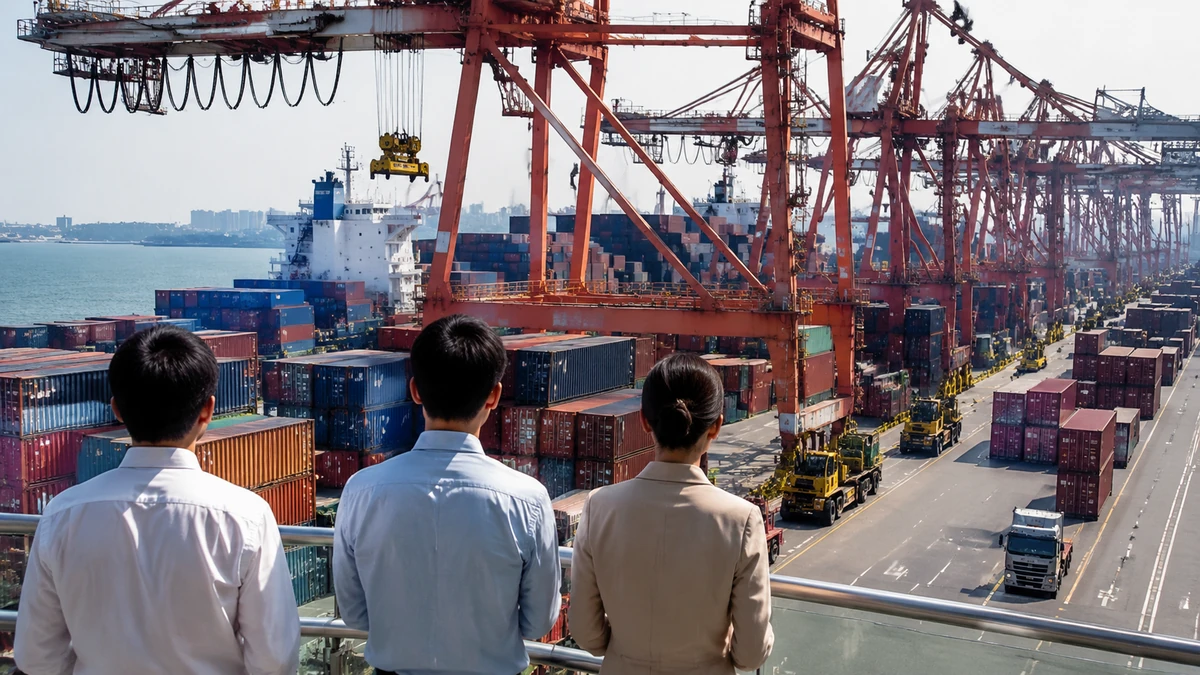
A tariff signal from Washington lands at a tense moment for Seoul
South Korea’s trade leadership is trying to calm markets after fresh concern that new U.S. trade action could leave Korean exporters paying more than expected to sell into one of their most important overseas markets. The immediate issue is a U.S. tariff inquiry conducted under Section 301 of the Trade Act, a tool Washington has often used to pressure trading partners over practices it says are unfair or inconsistent with American policy goals. For American readers, Section 301 is perhaps most familiar from the Trump-era trade fights with China, when it became shorthand for tariffs imposed outside the normal give-and-take of a free-trade agreement.
Now, the focus is South Korea, one of America’s closest allies in Asia and a major economic partner whose companies make everything from cars and batteries to semiconductors, steel and consumer electronics. South Korean Industry Minister Kim Jung-kwan said he had received reassurance from U.S. Commerce Secretary Howard Lutnick that Korean tariff burdens were not expected to rise above the 15% level tied to a prior U.S.-South Korea understanding. Kim’s account, delivered in a television appearance in Seoul, came after the Office of the U.S. Trade Representative announced the results of a Section 301 investigation related to forced labor and indicated a 12.5% tariff on South Korea.
That may sound like a technical dispute over decimal points. It is not. In export-heavy economies, even a tariff difference of a couple of percentage points can alter profit margins, pricing strategies and investment decisions. For companies negotiating multiyear supply contracts, the difference between 12.5% and something higher is not abstract. It can determine whether a shipment remains competitive, whether a factory expansion still pencils out, or whether a buyer shifts orders elsewhere.
That is why Kim’s retelling of his conversation with Lutnick drew such close attention in South Korea. His message was not that the problem had vanished. It was that the ceiling appeared, at least for now, to remain where Seoul believed it had already been set. In a period of global supply-chain realignment, geopolitical friction and financial market volatility, that kind of signal can matter almost as much as a formal document.
Why Section 301 matters far beyond trade lawyers
To understand why investors and exporters reacted so strongly, it helps to understand what Section 301 represents in American trade policy. It gives the U.S. government broad authority to investigate and respond to foreign practices it considers unreasonable or discriminatory. In practice, it is a pressure tool. It can be used to force concessions, reshape negotiations or signal that Washington is prepared to act even when a dispute does not move through slower multilateral channels.
For South Korea, that matters because the country’s economic model depends heavily on predictable access to global markets. The United States is not just another customer. It is a strategic export destination, a security ally and an anchor market for Korean firms that have spent years building manufacturing, logistics and distribution networks around American demand. When Washington changes the rules — or appears ready to — Korean companies have to recalculate quickly.
The reported USTR finding indicated a 12.5% tariff tied to the forced labor-related Section 301 inquiry. By itself, that would already force businesses to revisit pricing, shipping timelines and contract terms. But the bigger market fear was that 12.5% might not be the end of the story. The real anxiety was over whether the tariff burden could climb above 15%, the level South Korean officials say had been established in a previous U.S.-South Korea agreement.
That distinction is crucial. Markets dislike bad news, but they dislike moving targets even more. A known tariff can be modeled, hedged and priced into a deal. An unclear tariff regime, especially one that might rise further after an initial announcement, creates a much wider zone of uncertainty. That uncertainty is expensive. It can freeze orders, delay capital spending and lead companies to hold back until they have more confidence that the cost structure will not shift again.
Kim’s message was about more than the number 15
Kim’s most important point was not simply that he heard “don’t worry” from the U.S. side. It was that the basis for discussion, in Seoul’s view, remains an existing agreement rather than a newly imposed set of terms. For business readers in the United States, this is the difference between a one-time tariff dispute and a deeper test of whether prior understandings still mean what both sides thought they meant.
Trade relationships are built not only on tariff schedules but also on confidence that negotiated outcomes will hold. If companies believe that a settled number can suddenly be reopened without warning, they start assigning a political risk premium to future investments. That can be especially damaging between allies, where commercial ties are supposed to rest on a degree of strategic trust that goes beyond ordinary market competition.
Kim underscored that point when he said the foundation of trust lies in what the leaders of the two countries had already agreed to. That language matters. In Korean policy circles, references to agreements between top leaders often serve as a way of raising the stakes without turning immediately confrontational. It is a diplomatic way of saying: this is not just a bureaucratic misunderstanding; it touches the credibility of the broader relationship.
Americans may hear that and think of the way Washington talks about “rules-based order” in security policy. The trade equivalent is predictability. South Korea’s argument, as reflected in Kim’s remarks, is that the key issue is not whether the United States has policy concerns but whether those concerns are being managed within an already recognized framework. If the 15% level is treated as the effective boundary, markets can breathe easier. If that boundary can be moved, the damage goes well beyond the immediate tariff line.
Why South Korea is especially sensitive right now
The timing helps explain the intensity of the reaction in Seoul. South Korea is confronting a difficult external environment at the same time its companies are trying to navigate a global industrial reshuffle. Supply chains are being redesigned around security concerns, domestic manufacturing incentives and the politics of “friend-shoring,” the idea that countries should source critical goods from trusted partners. In theory, South Korea should benefit from that trend because it is a treaty ally of the United States with advanced manufacturing capacity. In practice, ally status does not eliminate cost pressure.
Korean firms are already dealing with swings in currency markets, elevated financing costs and fierce competition in industries with thin margins. The reported jump in the won-dollar exchange rate in overnight Seoul trading and the rise in U.S. Treasury yields cited in related market material only add to the strain. When borrowing costs rise and exchange rates move sharply, even a modest tariff shift can become far more painful. A company that might have absorbed a small trade cost in calmer conditions can find the same cost much harder to manage when money is expensive and currency volatility is high.
There is also a political economy dimension that Americans will recognize. South Korea’s large export manufacturers play a role in its economy that is somewhat analogous to the place giant industrial and technology firms occupy in the United States: they are major employers, symbols of national competitiveness and barometers of broader economic confidence. When trade friction threatens their margins, it becomes a national issue, not just a corporate one.
That is especially true because South Korea’s economic success story has long rested on turning a resource-poor country into a global manufacturing powerhouse. Korean policymakers are therefore highly attuned to anything that affects export competitiveness. A tariff is not just another policy change; it reaches directly into boardrooms, factory planning and household confidence about the economy.
A quick call, a public message and the market’s reading of both
Kim also described the speed of the exchange with the U.S. side, noting that the request for talks came quickly enough to underscore the sensitivity of the moment. That detail may sound incidental, but in trade disputes the pace and tone of communication can shape market psychology as much as the content. Businesses do not wait for every formal memo before making decisions. They listen to official language, track who is talking to whom and judge whether a negotiation channel is active or frozen.
From that standpoint, the reported video meeting and Kim’s subsequent public disclosure served a clear purpose: to show that negotiations are still functioning and that Seoul is not being left in the dark. In trade-sensitive markets, silence can be interpreted as breakdown. A high-level reassurance, even short of a binding document, can therefore help reduce speculation that relations are deteriorating faster than officials are prepared to admit.
This is where cultural context matters. In South Korea, government messaging during economic stress often aims for calibrated reassurance rather than dramatic declaration. Officials tend to acknowledge concern, cite ongoing consultations and emphasize continuity. That approach is meant to avoid either panicking markets or overpromising outcomes. Kim’s remarks fit that pattern. He did not say a new deal had been signed. He said the U.S. side indicated that the previously understood 15% level remained in place.
For American audiences, that might sound cautious to a fault. But caution is part of the point. Korean officials know that if they project too much confidence and later face a harsher final outcome, they risk losing credibility at home. By framing the message around the continuation of an agreed baseline rather than a triumphant breakthrough, Kim signaled guarded optimism while preserving room for further negotiation.
Forced labor, trade enforcement and the American domestic backdrop
The forced labor aspect of the Section 301 inquiry is also significant because it places the trade issue within a politically potent framework in Washington. In recent years, U.S. policymakers in both parties have become much more willing to tie trade access to labor rights, supply-chain transparency and national security concerns. That shift is visible in legislation, customs enforcement and executive branch investigations. It reflects a broader transformation in American politics: free trade, once defended primarily on price and efficiency grounds, is now judged increasingly through the lens of values, resilience and strategic rivalry.
That means even close allies can face stiff scrutiny if Washington believes supply chains touch practices it finds unacceptable. For South Korea, this creates a delicate balancing act. Korean companies want to expand in the United States and align with American industrial policy, especially in batteries, chips and electric vehicles. But they also operate across deeply interconnected Asian supply chains, where tracing every input to satisfy U.S. political and legal expectations can be difficult and costly.
American readers may compare this to the way U.S. retailers and manufacturers have had to adapt to stricter rules on sourcing from regions associated with forced labor allegations. The burden is not limited to one country or one product. It is part of a wider compliance revolution, where companies must prove not only that they can deliver goods cheaply and on time but that their supply chains meet increasingly demanding ethical and legal standards.
That broader trend helps explain why the South Korea case is being watched so closely. The question is not only what happens to one tariff rate. It is how Washington will treat allied economies as it hardens its trade enforcement toolkit. If even a close partner like South Korea sees tariff risk widen under a Section 301 framework, other U.S. allies will draw lessons about how much room they truly have under the new rules of American trade policy.
What is at stake for companies on both sides of the Pacific
For South Korean exporters, the immediate concern is straightforward: cost. Tariffs hit profit margins directly unless companies can pass them along to customers, and that is rarely easy in intensely competitive sectors. A carmaker may absorb part of the cost to protect market share. A materials supplier may try to renegotiate terms. A parts manufacturer may look for productivity gains elsewhere. None of those options is painless.
For American companies and consumers, the effect is more diffuse but still real. South Korean goods and components are woven deeply into the U.S. economy. Korean firms supply cars, steel, petrochemicals, batteries, electronics and intermediate goods used by American manufacturers. If tariff uncertainty pushes up prices or delays investment, U.S. buyers may face higher costs or reduced supply flexibility. In an economy still sensitive to inflation and supply disruptions, that matters.
There is also a strategic industrial angle. The United States has spent the past several years trying to attract more allied manufacturing, especially in sectors deemed critical to economic security. South Korean companies have been among the most active foreign investors responding to that push, particularly in batteries and advanced manufacturing. If those same companies begin to feel that the U.S. market is becoming less predictable on trade terms, it could complicate Washington’s broader effort to build trusted supply networks with friendly nations.
That does not mean companies will pull back overnight. South Korea’s business ties with the United States are too deep for that. But investment decisions are cumulative. Every episode that raises doubts about stability gets factored into the next board meeting, the next plant location decision and the next long-term contract. For an alliance that increasingly talks about economic security as part of national security, those commercial judgments carry weight far beyond quarterly earnings.
The real test is whether both sides preserve trust
In the end, this story is less about whether the tariff number is 12.5% or 15% than about whether the United States and South Korea can preserve confidence that their economic relationship is governed by durable understandings. Kim’s remarks suggest Seoul believes that line has not yet been crossed. His account of Lutnick’s reassurance gave markets a reason to think the two governments are still working from a shared baseline rather than drifting into a broader rupture.
That is encouraging, but it is not the same as resolution. Until there is formal clarity, companies will continue to watch every signal from Washington and Seoul for clues about the final shape of the tariff burden. Investors will do the same, parsing statements for hints about whether existing agreements are being upheld, revised or quietly eroded.
For American readers, the larger takeaway is that this is what modern alliance management looks like. It is not only about summit meetings, military exercises or speeches about shared democratic values. It is also about whether a Korean exporter can forecast its costs six months from now, whether an American manufacturer can rely on an allied supplier and whether both governments can translate strategic partnership into day-to-day commercial predictability.
That may sound less dramatic than a headline about geopolitical confrontation. But in many ways it is more consequential. Alliances endure not just because leaders say the right things, but because businesses, workers and investors believe the rules will hold. Right now, South Korea is listening closely for exactly that assurance from Washington. The market’s sensitivity says everything about how much is riding on the answer.
Comments
Post a Comment